



Last updated: June 22, 2026
Quick Answer: Ontario retailers purchasing disposable vapes at wholesale typically pay between $3 and $6 per unit for standard devices, with retail markups producing gross margins of 40% to 60%. After accounting for Ontario’s excise taxes, compliance costs, and overhead, net margins usually settle in the 25% to 40% range. The exact number depends on order volume, supplier pricing, product tier, and how well a retailer manages shrinkage and slow-moving inventory.
Key Takeaways
- Wholesale unit costs for disposable vapes in Ontario generally range from $3 to $6 for standard-capacity devices, with premium or high-puff-count models costing more.
- Gross margins of 40% to 60% are realistic for most Ontario retailers, depending on the product category and retail price point.
- Federal and provincial excise taxes directly reduce net margins and must be factored into every pricing calculation.
- Order volume matters. Retailers ordering 100+ units per SKU typically secure better per-unit pricing than those placing small, mixed orders.
- High-puff-count devices (10,000+ puffs) carry higher wholesale costs but can yield stronger dollar margins per unit sold.
- Compliance costs are not optional. Stocking only excise-stamped, Health Canada-compliant products protects both margins and the business license.
- Supplier choice is one of the biggest margin levers. Factory-direct distributors and those with no minimum order requirements can significantly improve profitability.
- Shrinkage, expired stock, and flavor mismatches are the most common margin killers for new vape retailers.
- Convenience store flavor restrictions (mint, menthol, and tobacco only) limit product variety in certain retail channels, affecting sales mix and margins.
What Margins Should Ontario Retailers Actually Expect on Wholesale Disposable Vapes?
Most Ontario vape retailers land between 40% and 60% gross margin on disposable vapes when buying at wholesale. That range is wide because it depends on three things: what you pay per unit, what you charge at retail, and how much product you move before it becomes dead stock.
Here’s how the math works in practice:
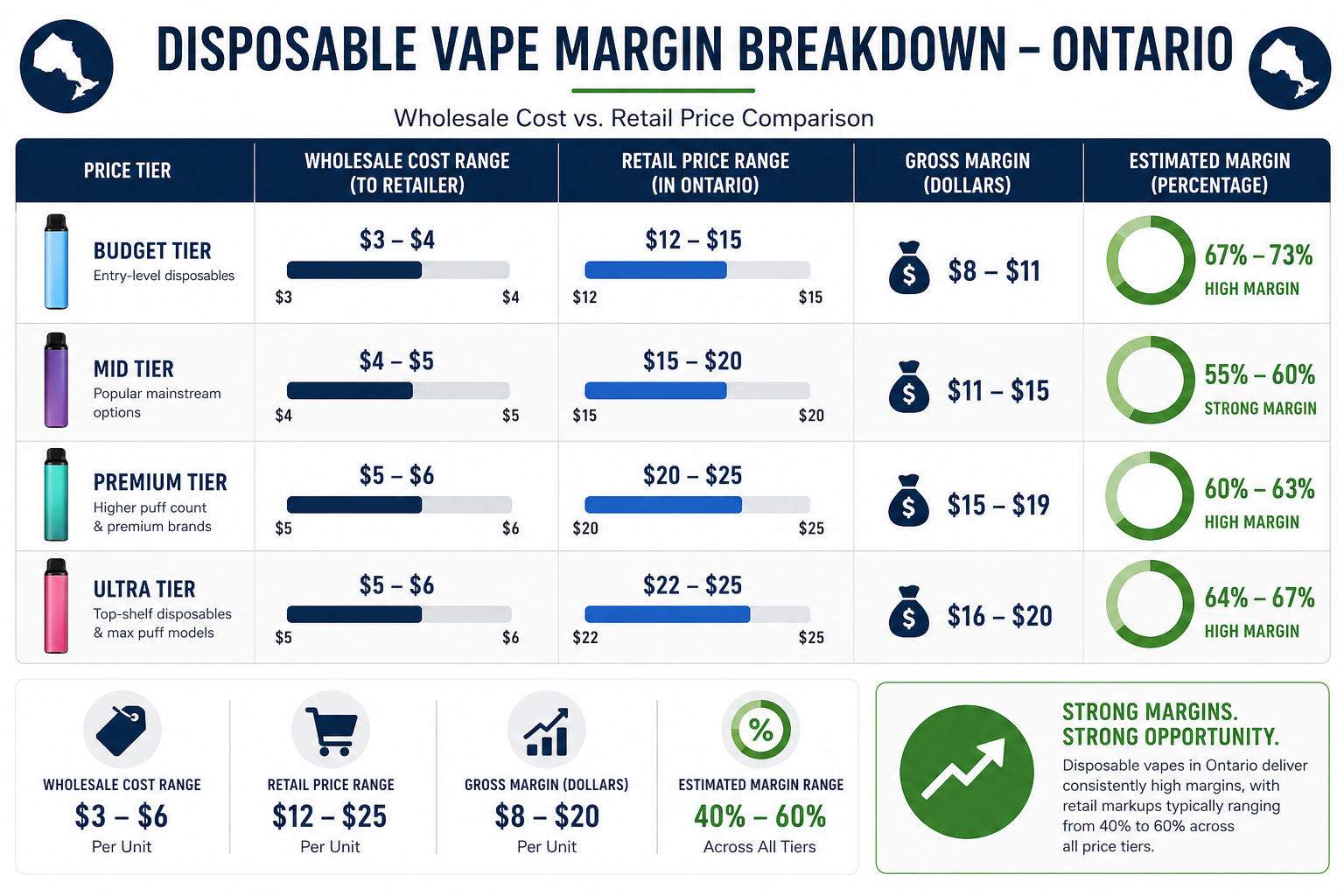
| Product Tier | Typical Wholesale Cost | Common Retail Price | Gross Margin |
|---|---|---|---|
| Budget (1,500–2,500 puffs) | $3.00–$4.00 | $9.99–$12.99 | 55%–70% |
| Mid-range (5,000–10,000 puffs) | $4.50–$6.00 | $14.99–$19.99 | 50%–65% |
| Premium (15,000–50,000+ puffs) | $8.00–$15.00+ | $22.99–$39.99 | 40%–55% |
Budget devices offer the highest percentage margins but lower dollar profit per sale. Premium devices flip that equation: lower percentage margins, but more cash in the register per transaction.
Common mistake: New retailers often stock only budget devices to maximize percentage margins, then wonder why revenue stays flat. A balanced product mix across price tiers typically performs better. For a broader look at how margins work across Canada, see this guide to selling wholesale disposable vapes in Canada.
How Do Excise Taxes and Compliance Costs Affect Disposable Vape Margins in Ontario?
Excise taxes are the single largest margin reducer for Ontario vape retailers. The federal excise duty on vaping products, combined with Ontario’s coordinated vaping duty, adds a per-unit cost that cannot be avoided on legal products.
As of 2026, the federal excise duty structure applies to all vaping liquids manufactured or imported into Canada. Ontario participates in the coordinated vaping product taxation framework, which means retailers pay both federal and provincial components. These costs are typically built into the wholesale price when purchasing from compliant distributors, but retailers should always verify.
Key compliance costs to budget for:
- Excise stamps: Every legal vape product sold in Ontario must carry a valid federal excise stamp. Products without stamps are illegal to sell and can result in fines or license revocation. Learn how to spot legal products by checking for federal excise stamps.
- Tobacco and Vaping Products Act (TVPA) compliance: Health Canada sets rules on nicotine concentration (capped at 20 mg/mL), e-liquid volume, and labeling.
- Smoke-Free Ontario Act (SFOA): Provincial rules govern where and how vape products can be displayed and sold. Retailers need to understand the Smoke-Free Ontario Act requirements to avoid costly penalties.
- Age verification systems: Both in-store and online retailers must verify that buyers are 19+. Online sellers face additional requirements for delivery verification.
The bottom line: After excise taxes and compliance overhead, expect net margins to drop 10 to 20 percentage points below gross margin. A product with a 55% gross margin might yield 35% to 40% net margin once all regulatory costs are included.
What Wholesale Price Ranges Are Available for Disposable Vapes in Ontario?
Wholesale prices for disposable vapes in Ontario vary significantly based on brand, puff count, e-liquid capacity, and order size. Here’s what the market looks like in 2026:
Standard-capacity devices (2 mL, 1,500–2,500 puffs):
- Wholesale: $3.00–$5.00 per unit
- These are the bread-and-butter products for convenience stores and gas stations
- Brands like STLTH ECO and VEEV NOW ULTRA fall in this category
- Compliant with Health Canada’s e-liquid capacity guidelines
Mid-capacity devices (5,000–10,000 puffs):
- Wholesale: $4.50–$8.00 per unit
- Popular in dedicated vape shops
- Brands include Geek Bar, Flavour Beast, and Elf Bar variants
High-capacity devices (15,000–50,000+ puffs):
- Wholesale: $8.00–$20.00+ per unit
- Products like the OVNS Pioneer 50K target volume consumers
- Higher wholesale cost but stronger dollar margins per sale
- Some multi-packs (e.g., STLTH Titan Max) wholesale at $40+ for bundled units
Decision rule: Choose budget devices if your customer base is price-sensitive and visits frequently. Choose premium devices if your customers prefer fewer purchases with longer-lasting products. Most successful retailers stock both.
For current wholesale pricing and product availability, browse wholesale disposable vapes for Ontario retailers.
How Does Supplier Choice Impact Wholesale Disposable Vape Margins?
Supplier selection is arguably the most controllable factor in your margin equation. The difference between a good and mediocre supplier can mean 5 to 15 percentage points of margin.
What to evaluate when choosing a supplier:
Per-unit pricing at your typical order volume. Some distributors offer factory-direct pricing with no minimum order quantity, which benefits smaller retailers. Others require bulk commitments but offer steeper discounts.
Shipping costs and speed. Ontario-based distributors with GTA warehouses can deliver faster and cheaper than out-of-province suppliers. Slow shipping means empty shelves, which means lost sales.
Product freshness and rotation. Vape products have a shelf life. Good suppliers rotate stock and don’t ship products that are already six months old.
Compliance guarantee. The supplier should only carry excise-stamped, Health Canada-compliant products. If a supplier offers suspiciously cheap products without stamps, walk away. The fines far exceed any margin savings.
Return and defect policies. Defective units are pure margin loss. A supplier with a clear return policy protects your bottom line.
Brand variety. Access to popular brands like STLTH, Geek Bar, Flavour Beast, and Elf Bar means you can stock what customers actually want. Limited selection forces customers to shop elsewhere.
For a detailed checklist, read this guide on choosing the best wholesale vape supplier in Ontario.
Edge case: Some distributors offer tiered pricing that rewards monthly volume commitments. If you can reliably sell 500+ units per month, negotiating a volume agreement can add 3% to 8% to your gross margin.

What Are the Biggest Margin Killers for Ontario Vape Retailers?
High wholesale margins on paper don’t always translate to high profits in practice. Here are the most common ways Ontario retailers lose margin on disposable vapes:
1. Dead stock and flavor mismatches Ordering 200 units of a flavor nobody wants ties up cash and shelf space. Start with small test orders of new flavors, then scale up based on actual sales data. Understanding which flavors are allowed in Ontario convenience stores is critical for retailers in that channel.
2. Theft and shrinkage Disposable vapes are small, high-value items. They’re easy to steal. Retailers without proper display security (locked cases, behind-counter placement) report shrinkage rates of 3% to 8%, which directly eats into margin.
3. Pricing too low to compete Undercutting competitors on price is tempting but rarely sustainable. A race to the bottom on retail pricing destroys margins for everyone. Compete on product selection, customer service, and convenience instead.
4. Non-compliant product purchases Buying cheap, unstamped products from grey-market suppliers might seem like a margin booster. In reality, it’s a business-ending risk. Ontario enforcement has increased, and fines for selling non-compliant vaping products can reach thousands of dollars per offense.
5. Ignoring the product mix Stocking only one price tier limits revenue. A customer who walks in wanting a premium device won’t buy a budget one as a substitute; they’ll just leave.
6. Poor inventory turnover Vape products sitting on shelves for months lose value. Consumer preferences shift quickly in this market. Aim for inventory turnover of 4 to 6 times per year on disposable vapes.
How Do Ontario’s Flavor Restrictions Affect Retail Margins?
Ontario convenience stores are limited to selling mint, menthol, and tobacco-flavored vape products. This restriction significantly affects the margin equation for retailers in that channel.
Impact on convenience store margins:
- Reduced SKU variety means fewer impulse purchases
- Mint and menthol flavors tend to be high-volume sellers, which partially offsets the limited selection
- Tobacco flavors move slower in most locations
- Customers seeking fruit or dessert flavors go to dedicated vape shops instead
Impact on dedicated vape shop margins:
- Vape shops can sell the full flavor range, giving them a competitive advantage
- Broader selection drives higher average transaction values
- More SKUs mean more inventory to manage, which increases the risk of dead stock
Choose your strategy based on your retail channel:
- If you operate a convenience store, focus on high-turnover mint and menthol products and keep inventory lean.
- If you run a vape shop, use flavor variety as your competitive edge but track sales velocity by SKU to avoid overstock.
For context on what disposable vapes are and why flavor matters to consumers, see this plain-English guide to disposable vapes.
How to Calculate Your True Net Margin on Disposable Vapes
Gross margin is only part of the picture. Here’s a step-by-step method to calculate your actual net margin per unit:
Step 1: Determine your landed cost
- Wholesale price per unit
- Plus shipping cost per unit (divide total shipping by units ordered)
- Plus any applicable excise tax not already included in wholesale price
- Equals: landed cost
Step 2: Set your retail price
- Research competitor pricing in your area
- Factor in your target margin
- Consider whether you’re positioning as budget, mid-range, or premium
Step 3: Calculate gross margin
- (Retail price – Landed cost) / Retail price x 100 = Gross margin %
Step 4: Subtract operating costs per unit
- Rent allocation per unit sold
- Staff cost per transaction
- Payment processing fees (typically 2%–3% for card transactions)
- Shrinkage allowance (budget 2%–5%)
- Marketing and signage costs
Step 5: Arrive at net margin
- Gross margin minus operating cost allocation = Net margin
Example calculation:
| Line Item | Amount |
|---|---|
| Wholesale cost | $4.50 |
| Shipping per unit | $0.30 |
| Landed cost | $4.80 |
| Retail price | $14.99 |
| Gross profit | $10.19 |
| Gross margin | 68% |
| Operating costs per unit | $4.50 (estimated) |
| Net profit per unit | $5.69 |
| Net margin | 38% |
This example shows a healthy net margin. But change the wholesale cost to $6.00 or the retail price to $11.99, and the math shifts dramatically. Every dollar matters at scale.
What Trends Are Shaping Wholesale Disposable Vape Margins in 2026?
Several market trends are actively influencing what Ontario retailers should expect for margins in 2026 and beyond:
1. The shift toward high-puff-count devices Consumers increasingly prefer devices with 10,000 to 50,000+ puff counts. These cost more wholesale but command higher retail prices. The trend benefits retailers who can stock premium inventory because the dollar margin per sale is higher, even if the percentage margin is slightly lower.
2. Increased regulatory enforcement Health Canada and Ontario’s provincial enforcement agencies are cracking down on non-compliant products. This is actually good for legitimate retailers because it reduces competition from grey-market sellers who undercut on price. Learn more about vaping laws in Ontario for 2026.
3. Brand consolidation The market is consolidating around a smaller number of trusted brands. Retailers stocking recognized names like STLTH, Geek Bar, Flavour Beast, and Elf Bar tend to see faster inventory turnover than those carrying unknown brands, even if the unknown brands offer slightly better wholesale pricing.
4. Direct-to-retailer distribution More manufacturers and primary distributors are selling directly to retailers, cutting out middlemen. This trend compresses the supply chain and can improve retailer margins by 5% to 10% compared to buying through secondary wholesalers.
5. The 20 mg/mL nicotine cap Canada’s nicotine concentration cap affects product formulation and, indirectly, consumer satisfaction and repurchase rates. Retailers should understand what the nicotine cap means to properly advise customers and reduce returns.
A Practical Margin Optimization Checklist for Ontario Retailers
Use this checklist to protect and improve your disposable vape margins:
- Compare pricing from at least three compliant wholesale suppliers before committing
- Verify all products carry valid federal excise stamps before accepting delivery
- Start with small test orders (25–50 units) of new SKUs before scaling
- Track sales velocity by SKU weekly and discontinue slow movers within 60 days
- Secure all vape products in locked displays or behind the counter
- Review retail pricing monthly against local competitors
- Negotiate volume discounts once monthly order volume exceeds 500 units
- Budget 2%–5% of inventory value for shrinkage
- Maintain a balanced mix of budget, mid-range, and premium products
- Stay current on regulatory changes that could affect product legality or taxation
Frequently Asked Questions
What is a good gross margin for disposable vapes in Ontario?
A gross margin of 40% to 60% is considered healthy for Ontario disposable vape retailers. Budget devices often yield higher percentage margins, while premium devices produce more dollar profit per sale.
How much do disposable vapes cost at wholesale in Ontario?
Standard disposable vapes wholesale for $3 to $6 per unit when ordering 100+ units. Premium high-puff-count devices can cost $8 to $20+ per unit at wholesale.
Do excise taxes reduce my vape margins?
Yes. Federal and provincial excise duties on vaping products are a significant cost. Most compliant distributors include excise tax in their wholesale pricing, but retailers should confirm this before calculating margins.
Can I sell any flavor of disposable vape in my Ontario convenience store?
No. Ontario convenience stores are restricted to mint, menthol, and tobacco flavors. Dedicated vape shops can sell the full range of flavors. This restriction affects product mix and margin potential for convenience retailers.
What is the minimum order for wholesale disposable vapes?
It varies by supplier. Some Ontario distributors have no minimum order quantity, while others require 50 to 100+ units per order. No-minimum suppliers are better for testing new products, while bulk-order suppliers typically offer lower per-unit pricing.
How do I verify that wholesale vape products are legal to sell in Ontario?
Check for a valid federal excise stamp on every product. Verify that the nicotine concentration does not exceed 20 mg/mL. Confirm the e-liquid volume complies with Health Canada regulations. Only buy from distributors who guarantee full compliance.
Are high-puff-count disposable vapes more profitable?
They can be. High-puff-count devices (10,000+ puffs) have higher wholesale costs but also command higher retail prices. The dollar margin per unit is typically greater, even if the percentage margin is slightly lower than budget devices.
How often should I reorder disposable vape inventory?
Most successful Ontario retailers reorder every two to four weeks, depending on sales volume. The goal is to maintain stock of top sellers without over-investing in slow-moving SKUs. Aim for inventory turnover of 4 to 6 times per year.
What happens if I sell non-compliant vape products in Ontario?
Selling products without proper excise stamps or that exceed nicotine limits can result in fines, product seizure, and potential loss of your retail license. The financial risk far outweighs any short-term margin gains from cheaper non-compliant stock.
Should I focus on one vape brand or carry multiple brands?
Carrying multiple recognized brands is generally better for margins. It gives customers choice, reduces the risk of being dependent on one supplier, and allows you to compare wholesale pricing across brands. Most successful shops carry three to five core brands.
How do online vape sales affect brick-and-mortar margins in Ontario?
Online retailers can sometimes offer lower prices due to reduced overhead. Brick-and-mortar stores compete on immediacy, in-person advice, and the ability to see and handle products before buying. Maintaining competitive (not necessarily lowest) pricing while offering superior service protects margins.
Where can I find wholesale vape suppliers in the GTA?
Several distributors operate warehouses in the Greater Toronto Area, offering same-day or next-day delivery. Look for suppliers who carry excise-stamped products, offer competitive pricing, and have clear return policies. For guidance, see this resource on vape wholesale suppliers in the GTA.
Conclusion
Understanding wholesale disposable vape margins is not just about knowing the spread between buy and sell prices. For Ontario retailers, the real margin picture includes excise taxes, compliance costs, shrinkage, inventory management, and supplier selection.
Here are the actionable next steps:
Audit your current supplier pricing against at least two alternatives. Even a $0.50 per-unit improvement across 500 monthly units adds $250 to your bottom line.
Verify compliance on every product in your current inventory. One fine for selling non-stamped products can wipe out months of profit.
Balance your product mix across budget, mid-range, and premium tiers. Track which products actually sell and cut the ones that don’t within 60 days.
Calculate your true net margin using the step-by-step method above. Many retailers overestimate profitability because they only look at gross margin.
Build relationships with compliant, Ontario-based distributors who can deliver quickly and consistently. Reliable supply keeps shelves stocked and customers coming back.
The Ontario disposable vape market in 2026 rewards retailers who combine smart purchasing with strict compliance and disciplined inventory management. Margins of 25% to 40% net are achievable and sustainable for retailers who do the work.
SEO Meta Title: Wholesale Disposable Vape Margins for Ontario Retailers
SEO Meta Description: Ontario retailers can expect 40-60% gross margins on wholesale disposable vapes. Learn pricing, compliance costs, and margin tips for 2026.