

Last updated: June 9, 2026
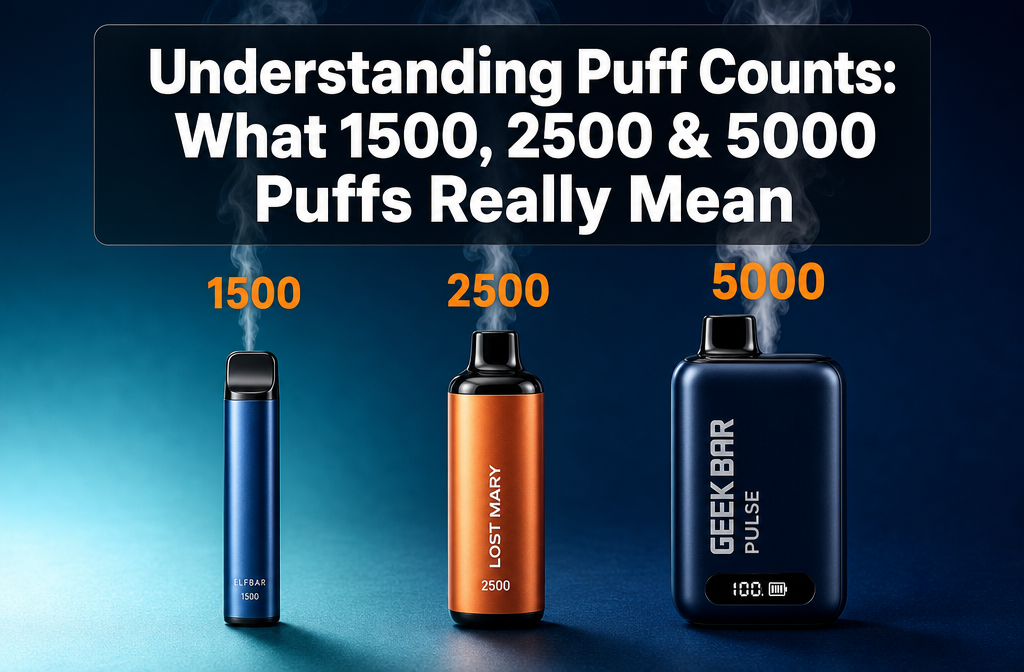
Quick Answer: Puff counts on disposable vapes are lab-tested estimates, not guarantees. A 1500-puff device typically holds about 4-5 ml of e-liquid, a 2500-puff device about 6-8 ml, and a 5000-puff device about 10-14 ml. Real-world usage almost always delivers fewer puffs than advertised because manufacturers test with short, machine-generated draws that don’t match how people actually vape.
Key Takeaways
- Puff counts are determined by machines taking consistent 1-2 second draws in a lab, not by real human usage patterns.
- A 1500-puff device generally lasts 2-5 days for a moderate user; a 5000-puff device can last 1-2 weeks.
- Longer, deeper draws drain both e-liquid and battery faster, reducing total puff count by 20-50% compared to the label.
- Battery capacity matters as much as e-liquid volume. If the battery dies first, leftover liquid is wasted.
- “Puff inflation” is a real marketing tactic where some brands advertise higher counts than their hardware can realistically deliver.
- Beginners and occasional users are generally better served by 1500-2500 puff devices to avoid waste and reduce upfront cost.
- Flavor choice does not significantly change puff count, but thicker e-liquid formulas can reduce output slightly.
- Puff count is best used as a comparison tool between devices in the same category, not as an exact promise.
What Exactly Is a Puff in a Vape Device?
A single puff is one inhalation from a vape device, measured from the moment the sensor activates to when the user stops drawing. In lab testing, manufacturers define a “standard puff” as a draw lasting about 1-2 seconds. That’s the baseline unit behind every puff count printed on packaging.
Most disposable vapes use a draw-activated sensor. When air flows through the mouthpiece, the sensor triggers the battery, which heats the coil, which vaporizes the e-liquid. One complete cycle of that process equals one puff.
Here’s the catch: not all puffs are equal. A casual 1-second sip uses far less e-liquid than a deep 4-second lung hit. The advertised puff count assumes the shorter, lighter draw every time. That’s why understanding puff counts — what 1500, 2500, and 5000 puffs really mean — requires looking beyond the number on the box.
Common mistake: Assuming a “puff” on a vape is identical to a drag on a cigarette. Cigarette drags tend to be shorter and more uniform. Vape draws vary widely based on the user, the device, and the moment.
How Long Do 1500 Puff Devices Actually Last?
A 1500-puff disposable vape typically lasts 2-5 days for someone who vapes moderately throughout the day. Light or occasional users may stretch it to a week or more.
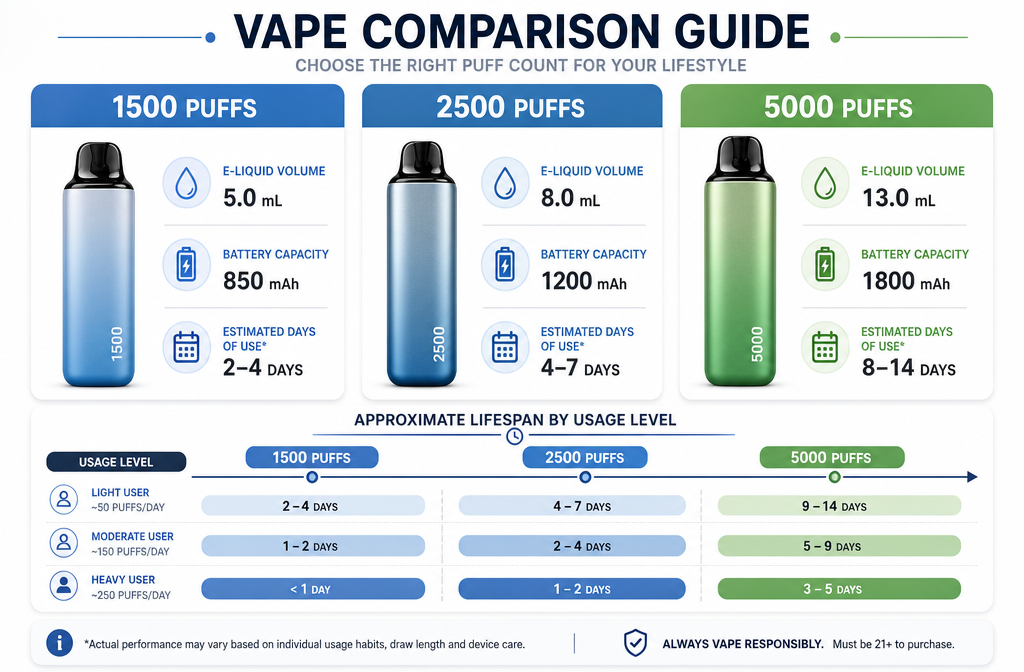
These devices usually contain 4-5 ml of e-liquid and a battery in the 650-850 mAh range. That’s enough to support the advertised count under lab conditions, but real-world use tends to cut the total by 20-40%.
Here’s a rough breakdown by user type:
| User Type | Estimated Daily Puffs | How Long 1500 Puffs Lasts |
|---|---|---|
| Light (social/occasional) | 50-100 | 2-4 weeks |
| Moderate (regular daily use) | 200-400 | 3-7 days |
| Heavy (frequent throughout the day) | 500+ | 1-3 days |
Choose a 1500-puff device if you’re new to vaping, want to try a flavor without committing to a larger device, or prefer a compact size that fits easily in a pocket. For help selecting the right option, see this guide on how to choose the right disposable vape.
Is a 2500 Puff Device Good for Occasional Smokers?
Yes. A 2500-puff device hits a practical middle ground for adults who vape occasionally or are transitioning from cigarettes. It offers enough capacity to last 1-2 weeks for light users without the bulk of a high-capacity device.
For context, one cigarette delivers roughly 10-15 puffs. A pack-a-day smoker takes about 200-300 puffs daily. At that rate, a 2500-puff device would last roughly 8-12 days — assuming real-world usage reduces the count by about 25% from the advertised number.
The 2500-puff tier typically includes:
- E-liquid volume: 6-8 ml
- Battery capacity: 900-1100 mAh
- Physical size: Slightly larger than a 1500-puff device, still pocket-friendly
Decision rule: If you vape fewer than 300 puffs per day and want something that lasts at least a week, 2500 puffs is a solid choice. If you vape more than that, consider stepping up to a 5000-puff option.
Are Higher Puff Count Vapes Better Quality?
Not necessarily. A higher puff count means more e-liquid and (usually) a bigger battery. It does not automatically mean better flavor, smoother vapor, or more reliable hardware.
Quality depends on the coil design, e-liquid formulation, battery management, and overall build. A well-made 1500-puff device can deliver a better experience than a poorly designed 5000-puff one. The puff count tells you about capacity, not craftsmanship.
That said, higher-capacity devices sometimes use better components because they’re priced higher and targeted at experienced users. But this is a trend, not a rule.
What to look for instead of just puff count:
- Consistent flavor from first puff to last
- No burnt taste near the end of the device’s life
- Battery that lasts until the e-liquid runs out (not before)
- Smooth, even vapor production
If you’ve experienced a burnt taste before the device was empty, that’s a quality issue, not a puff count issue. Learn more about why some disposable vapes taste burnt and how to avoid it.
How Much Does a 5000 Puff Disposable Vape Cost?
In Canada, a 5000-puff disposable vape typically costs between $15 and $30 CAD at retail, depending on the brand, nicotine strength, and where you buy it. Bulk or wholesale pricing can bring the per-unit cost down significantly.
Here’s how pricing generally scales with puff count:
| Puff Count | Typical Price Range (CAD) | Cost Per 100 Puffs (Estimated) |
|---|---|---|
| 1500 | $8-$15 | $0.53-$1.00 |
| 2500 | $12-$22 | $0.48-$0.88 |
| 5000 | $15-$30 | $0.30-$0.60 |
Higher puff counts generally offer better value per puff. But that only matters if you actually use the full device. A light user buying a 5000-puff device may find the flavor degrades or the battery weakens before they finish it.
For budget-conscious buyers in Ontario, there are affordable disposable vapes under $20 that balance cost and capacity well.
Which Puff Count Is Best for Beginners?
For most beginners, a 1500-puff device is the best starting point. It’s affordable, compact, and provides enough usage to determine whether vaping is a good fit without a large financial commitment.
Starting with a lower puff count also reduces the risk of common buying mistakes first-time users make, like overspending on a high-capacity device in a flavor they end up disliking.
Choose 1500 puffs if:
- This is your first vape purchase
- You want to test a specific flavor or nicotine level
- You prefer a smaller, lighter device
Consider 2500 puffs if:
- You’re fairly sure you’ll use it regularly
- You want slightly better per-puff value
- You’re switching from cigarettes and expect moderate daily use
Skip to 5000 puffs only if:
- You already know your preferred flavor and nicotine strength
- You vape consistently throughout the day
- You want to minimize how often you replace devices
Why Do Some Vapes Say 1500 Puffs but Run Out Faster?
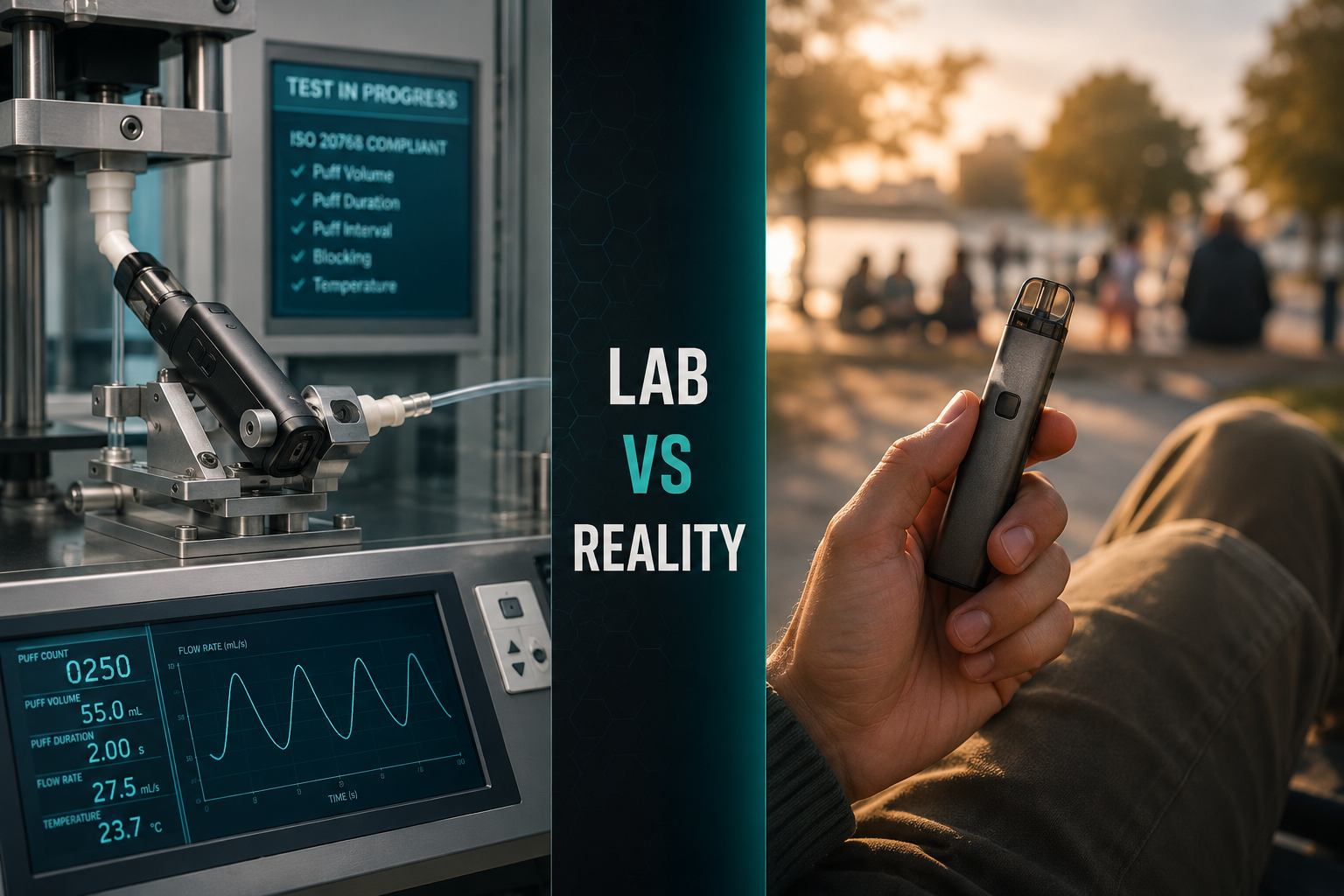
The most common reason is that your draws are longer or more frequent than the machine-tested standard. Manufacturers test with 1-2 second puffs at regular intervals. If your average draw is 3-4 seconds, you’re using roughly twice as much e-liquid per puff.
Other factors that cause devices to underperform their advertised count:
- Puff inflation in marketing: Some brands exaggerate puff counts to appear competitive. The e-liquid volume and battery size don’t actually support the claimed number.
- Battery dying before e-liquid runs out: If the battery capacity is too small relative to the e-liquid volume, the device stops working with liquid still inside. This is a design flaw, not a user error.
- Temperature and altitude: Extreme cold can reduce battery efficiency. High altitude can slightly alter vapor production.
- Chain vaping: Taking puffs in rapid succession heats the coil continuously, which burns through e-liquid faster and can also degrade flavor.
Quick check: Before buying, look at the e-liquid volume in milliliters. A rough benchmark is that 1 ml of e-liquid produces about 200-300 puffs under normal conditions. If a device claims 5000 puffs but only holds 8 ml of liquid, the math doesn’t add up. To understand the internal mechanics better, read about how disposable vapes work.
What Affects the Accuracy of Puff Count Claims?
Puff count accuracy depends on five main variables: draw length, draw frequency, e-liquid volume, battery capacity, and the manufacturer’s testing methodology. No single factor determines the outcome — they interact.
Draw length is the biggest variable. A 1-second puff uses a fraction of the e-liquid that a 4-second puff does. Most advertised counts assume draws of about 1 second.
Draw frequency matters because rapid, back-to-back puffs keep the coil hot and increase e-liquid consumption per draw. Spacing puffs out allows the wick to re-saturate, which improves efficiency.
E-liquid volume sets the theoretical ceiling. More liquid means more potential puffs. But the relationship isn’t perfectly linear — thicker e-liquid formulas (higher VG ratios) vaporize slightly differently than thinner ones.
Battery capacity sets a practical ceiling. A device with 12 ml of e-liquid but only a 400 mAh battery will likely die before the liquid runs out. Well-designed devices match battery size to liquid volume so both deplete at roughly the same rate.
Testing methodology varies between manufacturers. There’s no universal industry standard for what constitutes a “puff” in lab testing. One brand’s 1-second draw might be another brand’s 1.5-second draw, making cross-brand comparisons unreliable.
How Do Puff Counts Compare Across Different Brands?
Puff counts are not standardized across brands, so a “5000-puff” device from one manufacturer may deliver a very different experience than a “5000-puff” device from another.
The most reliable way to compare devices is to look at three specs together:
- E-liquid volume (ml) — the primary fuel source
- Battery capacity (mAh) — determines whether the device can use all the liquid
- Coil resistance (ohms) — affects how much liquid is vaporized per draw
A device with 12 ml of e-liquid and a 1000 mAh battery is likely to deliver more actual puffs than a device claiming the same puff count but holding only 8 ml with a 650 mAh battery.
Brand comparison tip: When shopping, compare devices within the same puff-count tier by their specs, not just their marketing claims. Check the best disposable vapes in Canada for 2026 for current options with transparent specifications.
Do Different Flavors Impact Puff Count?
Flavor choice has a minimal direct effect on puff count. The base e-liquid composition — specifically the ratio of vegetable glycerin (VG) to propylene glycol (PG) — matters more than the flavor itself.
That said, there are a few indirect effects worth noting:
- Sweeter flavors can gunk up coils faster, which may reduce vapor production toward the end of a device’s life. This doesn’t change the e-liquid volume, but it can make the last 10-15% of puffs taste off, leading users to discard the device early.
- Menthol or cooling flavors sometimes feel more satisfying per puff, which can lead users to take fewer draws overall, effectively extending the device’s lifespan.
- Thicker e-liquid formulas (higher VG) produce denser vapor but may wick more slowly, which can cause dry hits if you chain vape.
In practical terms, the difference between flavors is small enough that it shouldn’t be a major factor in choosing a puff count. Pick the flavor you enjoy and match the puff count to your usage habits.
Are 5000 Puff Devices Safe Compared to Lower Counts?
A 5000-puff device is not inherently more or less safe than a 1500-puff device. The safety profile depends on the quality of materials, battery construction, and e-liquid ingredients — not the puff count.
Higher-capacity devices do contain larger lithium-ion batteries, which means slightly more stored energy. Proper handling matters: avoid extreme heat, don’t puncture the device, and don’t leave it in direct sunlight for extended periods. These precautions apply to all disposable vapes, regardless of size.
For detailed guidance on battery-related concerns, review disposable vape battery safety issues and how to avoid them.
Edge case: Counterfeit or unregulated devices of any puff count pose genuine safety risks. Always purchase from reputable retailers and look for proper labeling, including nicotine content, ingredient lists, and manufacturer information.
Can You Tell How Many Puffs You’ve Taken?
Most basic disposable vapes do not include a puff counter. You won’t know the exact number of puffs you’ve taken unless the device has a digital display or connects to an app — features found only on some premium models.
For standard disposables, the best indicators that a device is running low are:
- Flavor weakening or tasting slightly burnt
- Vapor production decreasing noticeably
- The draw feeling tighter or less responsive
- A blinking LED light (on devices with indicator lights)
For a more detailed checklist, see how to tell when a disposable vape is near the end.
Practical workaround: If tracking usage matters to you, estimate your daily puffs for a day or two by counting consciously, then divide the advertised puff count by that number. This gives a rough estimate of how many days the device should last — adjusted downward by about 25% for real-world conditions.
Puff Count as a Buying Decision: A Quick Comparison
| Feature | 1500 Puffs | 2500 Puffs | 5000 Puffs |
|---|---|---|---|
| E-liquid volume | 4-5 ml | 6-8 ml | 10-14 ml |
| Battery (typical) | 650-850 mAh | 900-1100 mAh | 1000-1500 mAh |
| Lasts (moderate user) | 3-5 days | 5-10 days | 1-2 weeks |
| Best for | Beginners, flavor testing | Occasional to regular users | Daily, consistent users |
| Price range (CAD) | $8-$15 | $12-$22 | $15-$30 |
| Portability | Very compact | Compact | Slightly bulkier |
Conclusion
Understanding puff counts — what 1500, 2500, and 5000 puffs really mean — comes down to recognizing that these numbers are lab-generated estimates, not promises. They’re useful for comparing devices within the same category, but your actual experience will depend on how long your draws are, how often you vape, and whether the device’s battery can keep up with its e-liquid supply.
Actionable next steps:
- Match puff count to your habits. Light or new users should start with 1500-2500 puffs. Regular daily users benefit from 2500-5000 puffs.
- Check the specs, not just the label. Compare e-liquid volume and battery capacity across devices before buying. A higher puff count with a small battery is a red flag.
- Expect 20-40% fewer puffs than advertised. Plan your purchases accordingly, especially if you take longer draws.
- Buy from reputable sources. Avoid counterfeit devices by purchasing from established retailers with transparent product information.
- Try before you commit. If you’re unsure about a flavor or brand, start with a smaller device before investing in a 5000-puff option.
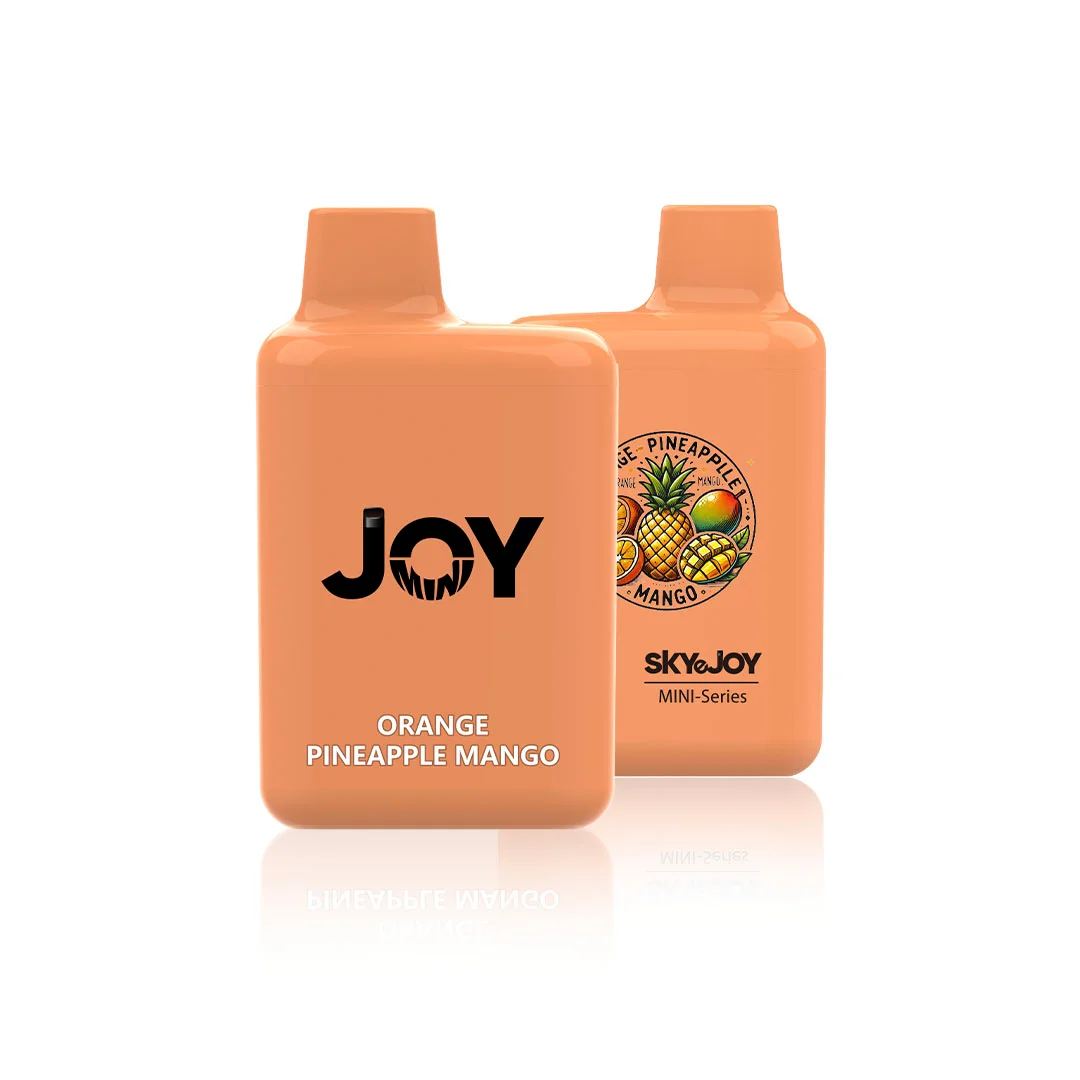
For a wide selection of clearly labeled disposable vapes with honest specifications, browse the full collection at Joy Mini.
Frequently Asked Questions
How many cigarettes is a 5000-puff vape equivalent to? Roughly 333 to 500 cigarettes, based on the estimate that one cigarette delivers about 10-15 puffs. This is an approximation — actual equivalence depends on draw length and nicotine concentration.
Can I make my disposable vape last longer? Yes. Take shorter draws (1-2 seconds), space your puffs out instead of chain vaping, and store the device at room temperature. These habits reduce e-liquid and battery consumption per session.
Why does my 5000-puff vape taste burnt before it’s empty? The coil may be overheating from chain vaping, or the wick isn’t re-saturating fast enough. In some cases, the battery is depleting before the e-liquid runs out, causing the coil to heat without enough liquid.
Is a 1500-puff vape enough for a weekend? For a light user taking 50-150 puffs per day, yes. For a heavy user, it may only last one day. Estimate your daily puff count to decide.
Do rechargeable disposable vapes give more accurate puff counts? Rechargeable disposables eliminate the problem of the battery dying before the e-liquid runs out, which can make the actual puff count closer to the advertised number. The e-liquid volume still sets the upper limit.
What does mAh mean on a vape device? mAh stands for milliampere-hours. It measures battery capacity. A higher mAh number means the battery can power the device for more puffs before dying.
Are puff counts regulated in Canada? Canadian regulations focus on nicotine concentration, labeling, and age restrictions rather than puff count accuracy. There is no federal standard requiring manufacturers to verify puff counts through independent testing.
Should I buy the highest puff count available? Not always. Buy based on your usage pattern. A 5000-puff device is wasteful if you only vape occasionally and the flavor degrades before you finish it.
Do all brands test puff counts the same way? No. There is no universal standard for puff testing. Draw length, draw interval, and machine settings vary between manufacturers, which is why cross-brand puff count comparisons are unreliable.
Can altitude or weather affect my puff count? Yes, marginally. Cold temperatures reduce battery efficiency, and high altitude can slightly alter vapor production. These effects are small but can shave off 5-10% of total puffs in extreme conditions.