

Last updated: August 10, 2026
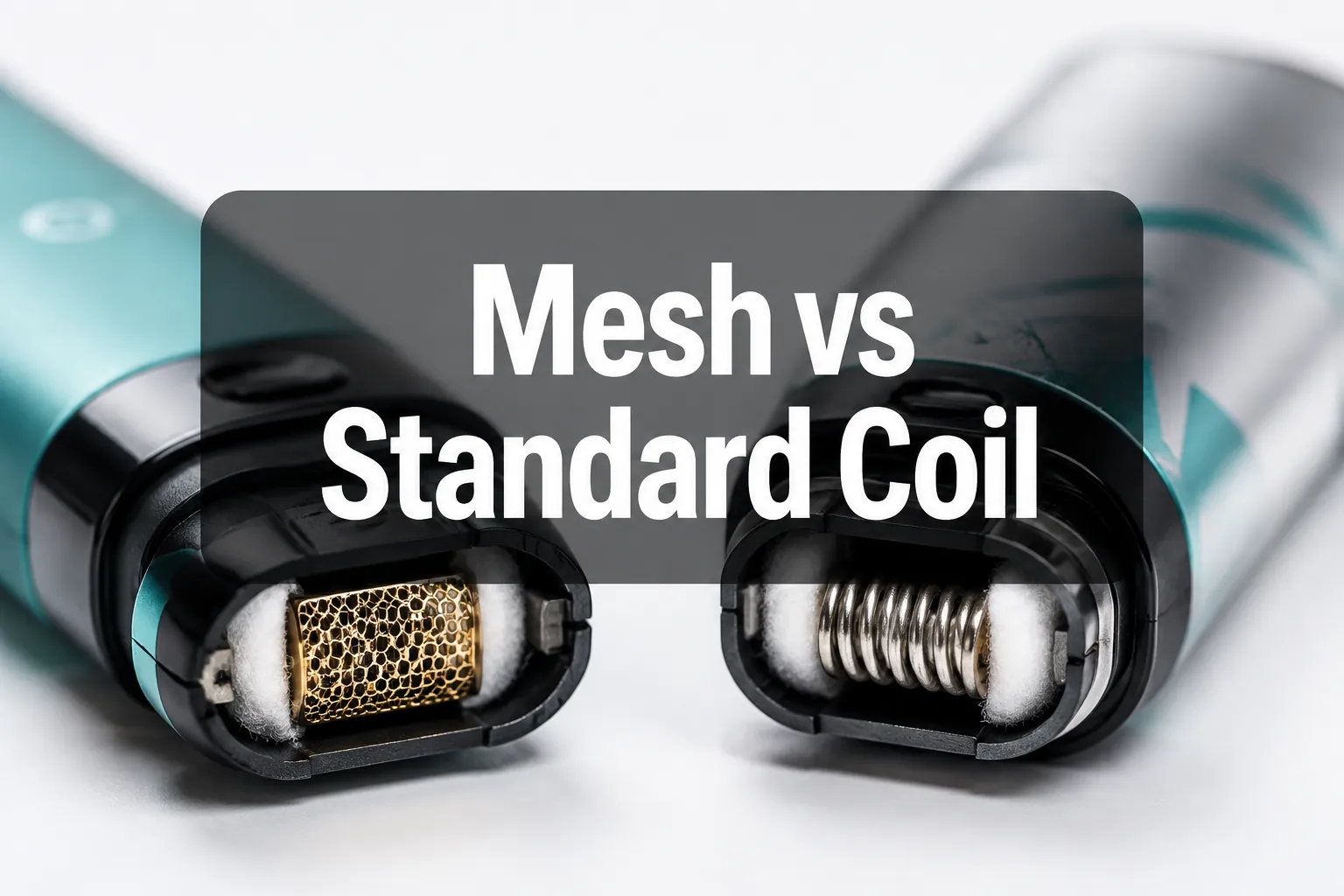
Quick Answer: A mesh coil uses a flat metal screen with hundreds of tiny holes to heat e-liquid across a wide surface area, while a standard coil uses a single wound wire spring that heats a narrow strip of wick. The practical result: mesh coils deliver more even heating, richer flavor, and denser vapor, but standard coils can be cheaper and sometimes last longer in low-power devices. Understanding mesh coil vs standard coil in disposable vapes and what the difference actually is comes down to how each design distributes heat, and how that affects your experience from the first puff to the last.
Key Takeaways
- Mesh coils heat e-liquid across a larger surface area, producing more consistent flavor and thicker vapor than standard wound wire coils.
- Standard coils use a simple spiral wire design that works well in low-power, budget disposables but can create uneven hot spots.
- Most mid-range and premium disposable vapes in 2026 ship with mesh coils as the default, especially devices rated above 2,500 puffs.
- Mesh coils generally last longer in higher-capacity devices, estimated at 8,000 to 12,000 puffs for single mesh versus 3,000 to 5,000 for traditional wire coils.
- Standard coil disposables typically cost less, making them a reasonable pick for budget-conscious buyers who prioritize value over vapor density.
- Burnt taste in mesh coil vapes usually comes from chain vaping or insufficient wicking time, not a flaw in the coil design itself.
- Mesh coils run at slightly higher temperatures but distribute heat more evenly, which actually reduces the risk of scorching the wick.
- You cannot swap a standard coil into a mesh coil device (or vice versa) in disposable vapes, the coil is factory-sealed and non-replaceable.
- Throat hit differs between the two: standard coils tend to deliver a sharper, more concentrated hit, while mesh coils produce a smoother draw.
- Dual mesh coils are increasingly common in high-puff-count disposables (40,000+ puffs), offering even richer flavor and longer life.
What Is a Mesh Coil in Vapes?
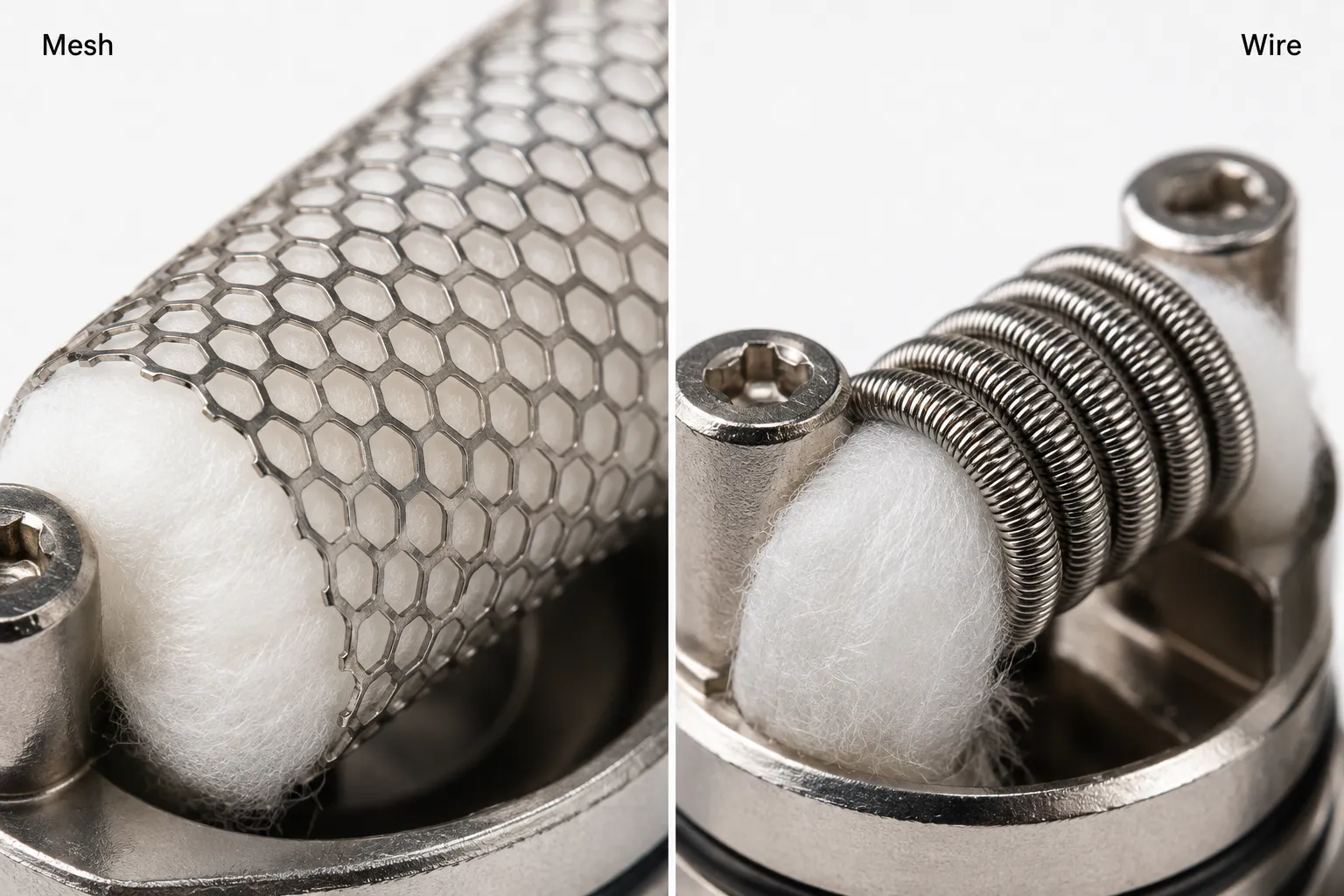
A mesh coil is a thin, flat strip of metal, usually kanthal or stainless steel, perforated with a grid of tiny holes, then shaped into a cylinder that wraps around the wicking material. Instead of heating one narrow point like a wire coil, the mesh screen contacts a much larger area of the cotton wick simultaneously.
This design matters because heat distribution is the single biggest factor in flavor quality. When a coil heats e-liquid unevenly, some spots get too hot (producing a harsh or burnt taste) while others stay too cool (wasting liquid). Mesh eliminates most of that unevenness.
Key characteristics of mesh coils in disposable vapes:
- Wide heating surface, roughly 2 to 3 times the contact area of a standard coil
- Lower resistance per unit of surface area, which allows the coil to heat up faster at lower wattage
- More uniform vapor production from edge to edge of the wick
- Better flavor accuracy, especially with complex or layered e-liquid blends
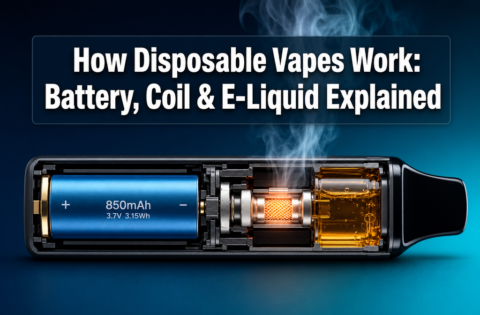
For a broader look at how coils, batteries, and e-liquid work together inside a disposable device, see How Disposable Vapes Work: Battery, Coil, and E-Liquid Explained.
How Does a Standard Coil Work in Disposable Vapes?
A standard coil (also called a regular or traditional coil) is a length of resistance wire, typically nichrome or kanthal, wound into a tight spiral, like a tiny spring. The cotton wick threads through the center of this spring, and when the battery fires, the wire heats up and vaporizes the e-liquid soaked into the cotton.
This design has been around since the earliest days of vaping. It’s simple, cheap to manufacture, and reliable in low-power applications.
How it heats: The wire gets hottest at the center of the coil and cooler toward the ends. This creates “hot spots”, small areas where the wick can dry out or scorch before the rest of the coil has fully vaporized the surrounding liquid.
Standard coils work well when:
- The device operates at low wattage (under 10W)
- The e-liquid is thin and wicks quickly
- The user takes slow, spaced-out draws
- Budget is the primary concern
Common mistake: Assuming a standard coil is “bad.” It’s not. For a compact, low-cost disposable rated at 600 to 1,500 puffs, a standard coil does the job fine. The limitations only become noticeable in higher-capacity devices or when flavor accuracy matters a lot.
Mesh Coil vs Regular Coil: Which Is Better?
Neither is universally better, the right choice depends on what matters most to the user. But for the majority of disposable vape buyers in 2026, mesh coils offer a noticeably better experience in flavor, vapor density, and consistency.
Here’s a direct comparison:
| Feature | Mesh Coil | Standard Coil |
|---|---|---|
| Heating surface area | Large (flat screen) | Small (wound wire) |
| Flavor quality | Rich, accurate, consistent | Decent but can be uneven |
| Vapor production | Dense, full clouds | Moderate, thinner clouds |
| Heat distribution | Very even | Prone to hot spots |
| Typical lifespan (puffs) | 8,000-12,000 (single mesh) | 3,000-5,000 |
| Risk of burnt hits | Lower | Higher with chain vaping |
| Throat hit | Smoother | Sharper, more concentrated |
| Cost per device | Slightly higher | Lower |
| Best for | Flavor chasers, cloud seekers | Budget buyers, light users |
Decision rule: Choose mesh if flavor and vapor density are priorities. Choose standard if cost is the main factor and the device is rated under 2,000 puffs.
For help picking the right device overall, check out How to Choose the Right Disposable Vape: A Decision Framework.
Do Mesh Coils Last Longer Than Standard Coils?
In most disposable vapes, yes, mesh coils last significantly longer than standard coils. The reason is straightforward: because mesh distributes heat across a wider area, no single point on the wick gets overheated and degrades prematurely.
Estimated coil lifespan by type:
- Traditional wire coil: approximately 3,000 to 5,000 puffs
- Single mesh coil: approximately 8,000 to 12,000 puffs
- Dual mesh coil: approximately 15,000 to 25,000+ puffs
These numbers come from engineering analyses of coil degradation in comparable devices. Real-world results vary based on puff duration, ambient temperature, and e-liquid viscosity.
Edge case: In very low-power disposables (under 800 puffs), a standard coil may actually outlast a mesh coil because the device runs out of e-liquid or battery long before either coil type degrades. The longevity advantage of mesh only becomes meaningful in devices rated above roughly 2,500 puffs.
To understand what puff counts actually mean in practice, see Understanding Puff Counts: What 1500, 2500, and 5000 Puffs Really Mean.
Mesh Coil Disposable Vapes: Is There a Price Difference?
Mesh coil disposables historically cost about 20 to 30 percent more than equivalent standard coil devices. That gap has narrowed considerably in 2026 as mesh has become the default in most mid-range products.
Here’s what drives the price difference:
- Manufacturing cost: Mesh coils require precision stamping or laser-cutting of the metal screen, which costs more than simply winding wire.
- Associated components: Mesh coils often come in devices with larger batteries and more e-liquid, which adds to the total cost.
- Market positioning: Brands use mesh coils in their mid-tier and premium lines, so the price reflects the overall device quality, not just the coil.
Practical reality for Canadian buyers: Entry-level disposables under $10 CAD still commonly use standard coils. Devices in the $12 to $20 range almost always feature mesh coils. The price-per-puff is often lower with mesh because the device lasts longer. For affordable options in Ontario, see Affordable Disposable Vapes in Ontario Under $20.
Why Does My Mesh Coil Vape Taste Burnt?
A burnt taste from a mesh coil vape almost always means the wick has dried out in one or more spots before fresh e-liquid can soak in. Even though mesh coils are designed to reduce this problem, it still happens under certain conditions.
Most common causes:
- Chain vaping, taking multiple draws in rapid succession without giving the wick 15 to 20 seconds to re-saturate
- Low e-liquid level, when the tank is nearly empty, the wick can’t pull enough liquid to stay wet
- High ambient heat, storing the device in a hot car or direct sunlight can thin the e-liquid and cause it to wick unevenly
- Manufacturing defect, occasionally, the mesh screen isn’t properly aligned with the wick, creating a dry spot from the start
Quick fix: If the burnt taste just started, set the device down for 30 to 60 seconds. This gives the cotton time to re-absorb liquid. If the taste persists after several minutes of rest, the wick is likely permanently scorched and the device needs to be replaced.
For a deeper dive into this issue, read Why Some Disposable Vapes Taste Burnt and How to Avoid It.
Are Mesh Coils Hotter Than Standard Coils?
Mesh coils can reach similar or slightly higher peak temperatures than standard coils, but they distribute that heat much more evenly. The distinction matters: a standard coil might hit 250°C at its center hot spot while the edges sit at 180°C, whereas a mesh coil might heat the entire surface to a more uniform 210 to 220°C.
What this means for the user:
- Mesh coils feel warmer on the draw because more vapor is produced per puff
- The even heat means less risk of scorching the wick despite the higher overall temperature
- Standard coils can feel hotter at the throat because the concentrated heat from hot spots produces sharper, more irritating vapor
Temperature and safety: In disposable vapes, the battery’s output is fixed, so users can’t adjust wattage. The device manufacturer calibrates the battery to match the coil’s resistance. A well-designed mesh coil disposable won’t overheat because the power delivery is matched to the coil’s thermal profile.
For battery safety considerations, see Disposable Vape Battery Safety: Lithium-Ion Risks and How to Store Devices.
Mesh Coil Vape Pros and Cons
Understanding the full picture of mesh coil vs standard coil in disposable vapes, what the difference actually is in daily use, requires weighing both sides honestly.

Pros of Mesh Coils
- Superior flavor reproduction, the even heating brings out subtle notes in complex e-liquid blends
- Denser vapor clouds, more surface area means more liquid vaporized per draw
- Longer coil life, fewer hot spots means less wick degradation over time
- Faster ramp-up, mesh heats to operating temperature almost instantly
- Smoother throat hit, the even vapor stream is less harsh on the throat
- Consistent performance, flavor and vapor stay steady from the first puff to near the end of the device’s life
Cons of Mesh Coils
- Higher device cost, mesh coil disposables tend to cost more upfront
- Faster e-liquid consumption, because more liquid is vaporized per puff, the tank can empty faster relative to puff count
- Not ideal for mouth-to-lung (MTL) purists, some users prefer the tighter, more concentrated draw of a standard coil
- Slightly higher battery drain, the lower resistance of mesh coils draws more power per activation
- No user serviceability, if the mesh coil fails in a disposable, the entire device is done (though this applies to standard coils too)
Can You Use a Standard Coil in a Mesh Coil Vape?
No. In disposable vapes, the coil is permanently installed during manufacturing and cannot be removed, swapped, or replaced by the user. The device is designed as a sealed, single-use unit where the coil, wick, e-liquid reservoir, and battery are all integrated.
This is different from refillable pod systems or mod kits, where users can buy replacement coil heads in either mesh or standard configurations. In those systems, coil compatibility depends on the specific pod or tank model, a mesh coil head designed for one brand’s pod won’t fit another.
Bottom line for disposable vape buyers: The coil type is chosen at the point of purchase. Check the product label or description before buying. Most manufacturers now list the coil type in the specs. For guidance on reading those specs, see How to Read a Disposable Vape Label: Specs, Warnings, and What Matters.
Who Should Use Mesh Coil Vapes?
Mesh coil disposables are the better fit for most adult vapers in 2026, but they’re especially well-suited to certain user profiles.
Mesh coils are ideal for:
- Flavor-focused vapers who want accurate, layered taste from their e-liquid
- Cloud chasers who enjoy visible, dense vapor production
- High-puff-count users who go through a device quickly and need consistent performance over thousands of puffs
- Users switching from smoking who want a smooth, satisfying draw without harshness
- Anyone buying devices rated above 2,500 puffs, where mesh’s longevity advantage becomes meaningful
Standard coils may be better for:
- Budget-conscious buyers looking for the lowest possible price per device
- Very light or occasional vapers who only take a few puffs per day and won’t notice the flavor difference
- Users who prefer a tight MTL draw with a sharper throat hit
- Anyone buying ultra-compact, low-puff-count disposables (under 800 puffs) where the coil type has minimal impact
Mesh Coil Vape Common Problems
While mesh coils are generally more reliable than standard coils, they’re not problem-free. Here are the issues users most commonly report:
1. Faster e-liquid depletion Because mesh vaporizes more liquid per puff, some users find their device runs out of e-liquid before the battery dies. This is more of a design balance issue than a coil flaw, it happens when manufacturers pair a mesh coil with an undersized e-liquid reservoir.
2. Gurgling or spitting If e-liquid floods the mesh screen (often from temperature changes or altitude shifts), the device can gurgle or spit liquid into the mouthpiece. A few firm flicks of the device usually clears excess liquid from the coil.
3. Inconsistent wicking in cold weather Thicker e-liquids (high VG blends) can struggle to wick properly in cold temperatures. The wide surface area of a mesh coil demands a steady supply of liquid, and cold-thickened juice can’t keep up. Storing the device at room temperature helps. For more on temperature-related issues, read Storing Disposable Vapes in Hot Cars and Ontario Winters.
4. Occasional dry hits despite liquid remaining Air bubbles can form in the wick channel, preventing liquid from reaching the mesh. Gently tapping the device on a flat surface can dislodge the bubble.
5. Auto-fire or continuous activation This is rare and usually a battery or sensor issue rather than a coil problem, but it’s worth mentioning because mesh coils draw more current. If a device auto-fires, stop using it immediately.
Do Mesh Coils Produce More Vapor?
Yes. Mesh coils produce noticeably more vapor than standard coils at the same power level. The larger heating surface vaporizes more e-liquid per draw, which translates directly into denser, more visible clouds.
How much more? Exact numbers depend on the specific device, but in blind comparison tests conducted in 2025 and updated in 2026, mesh coil disposables consistently produced fuller, denser vapor than their standard coil counterparts across multiple brands and e-liquid types.
This extra vapor production is one of the main reasons mesh has become the default in modern disposables. For users who enjoy visible clouds, mesh is the clear winner. For users who prefer a more discreet, low-vapor experience, a standard coil device or a tighter MTL pod system may be more appropriate.
Mesh Coil vs Standard Coil: Throat Hit Differences
The throat hit, that slight catch or “kick” at the back of the throat, feels different between the two coil types, and this matters a lot for former smokers.
Standard coils produce a more concentrated, sharper throat hit. Because the vapor is generated from a smaller area and can be slightly hotter at the center, it tends to feel more intense. Many former smokers prefer this sensation because it more closely mimics the feel of cigarette smoke.
Mesh coils deliver a smoother, more diffused throat hit. The even heating creates a more uniform vapor stream that spreads across the throat rather than hitting one spot. This feels less harsh but can seem less “satisfying” to users who crave that sharp kick.
Adjusting throat hit with nicotine type: The coil is only one factor. Nicotine salt e-liquids (common in disposables) already produce a smoother hit than freebase nicotine. Pairing nicotine salts with a mesh coil creates a very smooth experience. Users who want more throat hit from a mesh coil device should look for higher nicotine concentrations (within Canada’s 20 mg/mL regulatory cap). For more on this topic, see Nicotine Salts vs Freebase Nicotine in Disposable Vapes.
How Long Do Mesh Coils Last Compared to Standard Coils?
Mesh coils last roughly two to three times longer than standard coils in comparable disposable vape devices. This is the single biggest practical advantage of mesh technology for high-usage vapers.
Longevity breakdown:
- Standard wire coil: 3,000 to 5,000 puffs before noticeable flavor degradation
- Single mesh coil: 8,000 to 12,000 puffs with consistent flavor
- Dual mesh coil: 15,000 to 25,000+ puffs, now common in high-capacity rechargeable disposables
Why mesh lasts longer:
The even heat distribution means no single point on the wick gets repeatedly scorched. In a standard coil, the hot spots gradually carbonize the cotton, building up a layer of burnt residue that degrades flavor. Mesh avoids this by spreading the thermal load across the entire wick surface.
What shortens mesh coil life:
- Chain vaping (the number one factor)
- Very sweet e-liquids (sucralose caramelizes on the mesh and gunks it up)
- Extreme temperatures (both hot and cold)
- Manufacturing quality, cheap mesh coils with inconsistent hole patterns degrade faster
Practical tip: If a disposable vape starts tasting slightly off or muted toward the end of its life, that’s the coil beginning to degrade. It doesn’t necessarily mean the device is empty. For signs that a device is nearing the end, see How to Tell When a Disposable Vape Is Near the End.
The State of Mesh vs Standard Coils in 2026 Disposables
The market has largely settled the debate. Most modern disposable vape brands now ship with mesh coils as the default, particularly in devices rated above 2,500 puffs. Dual mesh coils are increasingly standard in the 40,000+ puff category, where they provide richer flavor and more consistent performance across the device’s entire lifespan.
Standard coils haven’t disappeared. They still serve a purpose in the ultra-budget segment and in very small, low-puff-count devices where manufacturing cost matters more than performance. But for the average adult vaper buying a mid-range disposable in Canada in 2026, mesh is what they’ll get, and what they should want.
The trend is clear: as disposable vapes get larger, more powerful, and longer-lasting, mesh coil technology scales better than traditional wire. The broader heating surface handles higher e-liquid volumes more efficiently, and the even heat distribution keeps flavor consistent over thousands of additional puffs.
Conclusion
The difference between mesh and standard coils in disposable vapes comes down to surface area and heat distribution. Mesh coils heat more e-liquid more evenly, which produces better flavor, denser vapor, and longer coil life. Standard coils are simpler and cheaper but create hot spots that limit their performance in higher-capacity devices.
Actionable next steps:
- Check the coil type before buying. Look at the product specs or label, most brands now list whether the device uses mesh, dual mesh, or standard wire coils.
- Match the coil to your priorities. If flavor and vapor density matter, go mesh. If cost is the only concern and the device is under 1,500 puffs, standard is fine.
- Avoid chain vaping with any coil type. Give the wick 15 to 20 seconds between draws to prevent burnt hits.
- Consider puff count when evaluating value. A mesh coil device that costs $2 more but lasts twice as long is the better deal per puff.
- Store devices properly. Both coil types perform worse in extreme temperatures, but mesh coils are more sensitive to cold-thickened e-liquid.
Understanding mesh coil vs standard coil in disposable vapes, what the difference actually is, puts buyers in a stronger position to choose the right device for their needs and budget.
Frequently Asked Questions
What is the main difference between mesh and standard coils? A mesh coil uses a flat perforated metal screen to heat e-liquid across a wide surface, while a standard coil uses a wound wire spring that heats a narrow strip of wick. Mesh produces more even heat, better flavor, and denser vapor.
Are mesh coil disposable vapes worth the extra cost? For most users, yes. The improved flavor, vapor production, and longer coil life typically offset the slightly higher price. The cost difference has also narrowed significantly in 2026 as mesh has become the industry standard.
Can I replace the coil in a disposable vape? No. Disposable vapes are sealed units with factory-installed coils. The coil cannot be removed, cleaned, or swapped. Once the coil degrades or the e-liquid runs out, the device is done.
Why does my new mesh coil vape taste burnt right away? This usually indicates a manufacturing defect where the wick wasn’t properly saturated with e-liquid at the factory. It can also happen if the device was stored in extreme heat before purchase. If a brand-new device tastes burnt from the first puff, it’s likely defective.
Do mesh coils use more battery? Yes, slightly. Mesh coils typically have lower resistance, which draws more current from the battery per puff. However, manufacturers account for this by pairing mesh coils with appropriately sized batteries.
Which coil type is better for mouth-to-lung vaping? Standard coils tend to suit tight MTL draws better because they produce a more concentrated, sharper throat hit. Mesh coils can work for MTL but deliver a smoother, less intense sensation.
How can I tell if my disposable vape has a mesh coil? Check the product packaging, label, or online product listing. Most manufacturers prominently advertise mesh coils as a feature. If the coil type isn’t listed, the device likely uses a standard wire coil.
Do mesh coils work better with nicotine salts or freebase nicotine? Mesh coils pair well with both, but they’re especially good with nicotine salts because the smooth heating complements the already-smooth character of salt nicotine. The combination produces a very comfortable draw.
What is a dual mesh coil? A dual mesh coil uses two mesh screens instead of one, doubling the heating surface area. These are found in high-capacity disposables (typically 40,000+ puffs) and deliver even richer flavor and denser vapor than single mesh designs.
Will mesh coils eventually replace standard coils entirely? In disposable vapes, mesh is already the dominant technology for mid-range and premium devices. Standard coils will likely persist in the ultra-budget segment, but the trend strongly favors mesh across the industry.
Is there a health difference between mesh and standard coils? Both coil types vaporize the same e-liquid. The coil material (usually kanthal or stainless steel) is the same in both designs. No credible research as of 2026 suggests a meaningful health difference between the two coil types when used as intended.