

Last updated: August 13, 2026
Quick Answer
A Canadian vape wholesale invoice contains more than just a product price. It includes federal excise duty (currently $1.12 per 2 mL for the first 10 mL), a possible matching provincial vaping duty in specified provinces, and GST or HST calculated on the excise-inclusive price. To find real margins, subtract all excise duties and consumption taxes from the retail selling price before comparing supplier quotes. Skipping this step can make a 40% gross margin look healthy when the actual net margin is closer to 10%.
Key Takeaways
- Federal vaping excise duty is $1.12 per 2 mL (or gram) for the first 10 mL, and $1.12 per 10 mL for volume above 10 mL, effective since July 1, 2024.
- In specified provinces (Ontario, Quebec, Alberta, Manitoba, New Brunswick, PEI, Nova Scotia, Yukon, NWT, and Nunavut), an equal provincial duty doubles the excise to $2.24 per bracket.
- GST/HST is calculated on the selling price that already includes excise duty, so taxes compound on top of the duty.
- A 30 mL bottle in a specified province can carry $15.68 in combined excise alone, which can consume over 75% of a $20 wholesale price.
- The excise is volume-based, not percentage-based, so lower-priced products lose a larger share of their price to duty.
- Retailers do not remit excise directly; it is paid by the manufacturer or importer and passed through on the invoice.
- Comparing wholesale prices between distributors requires stripping out excise and tax to find the true product cost.
- Mid-period excise rate changes apply based on when the product was packaged, not when it was invoiced.
- Every legitimate vape product in Canada must carry a federal excise stamp, which confirms duty was paid.
What Line Items Should You See on a Vape Distributor Invoice?
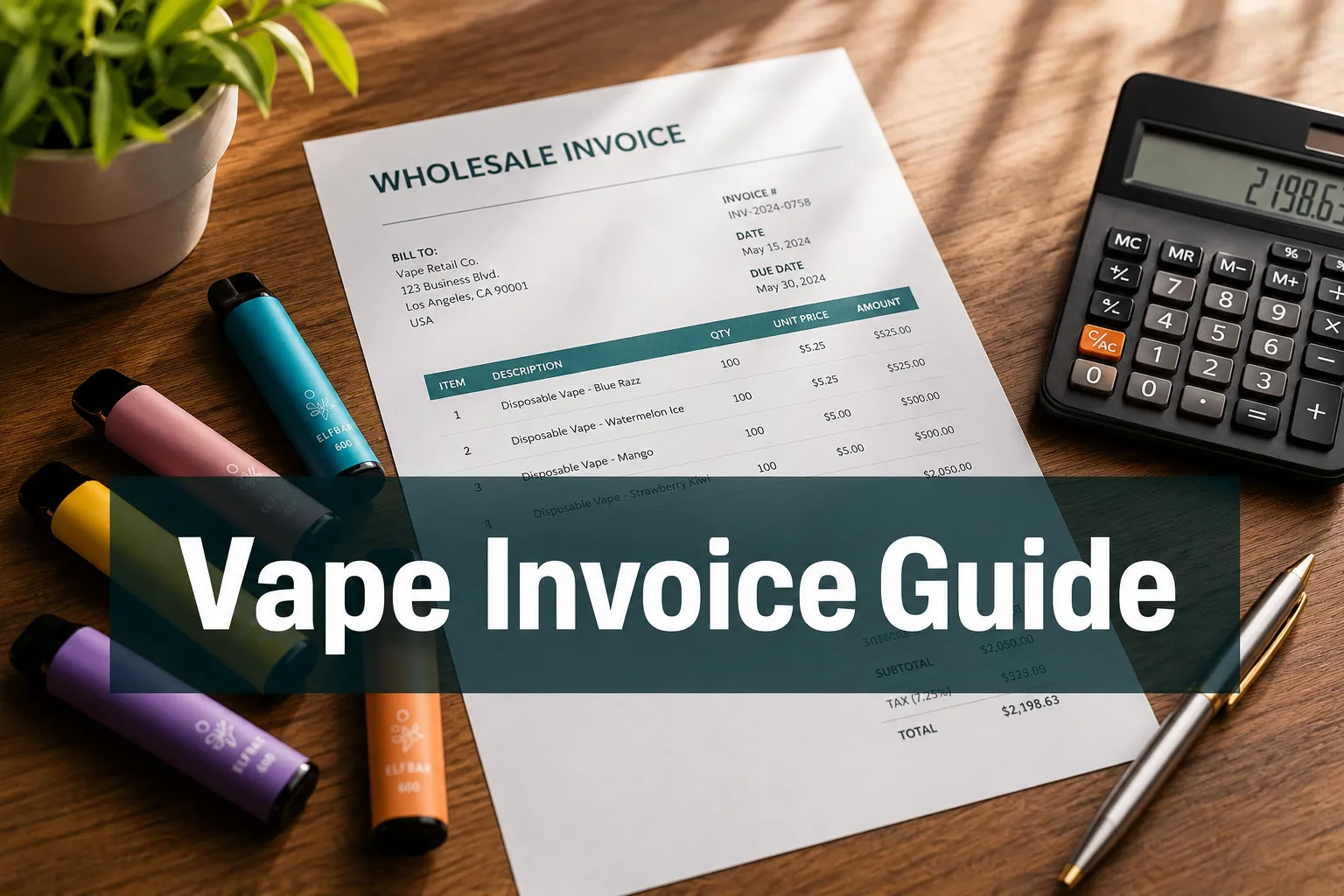
A properly formatted vape wholesale invoice in Canada should show at least six distinct categories of information. Missing any of these is a red flag that the distributor may not be operating within the legal framework.
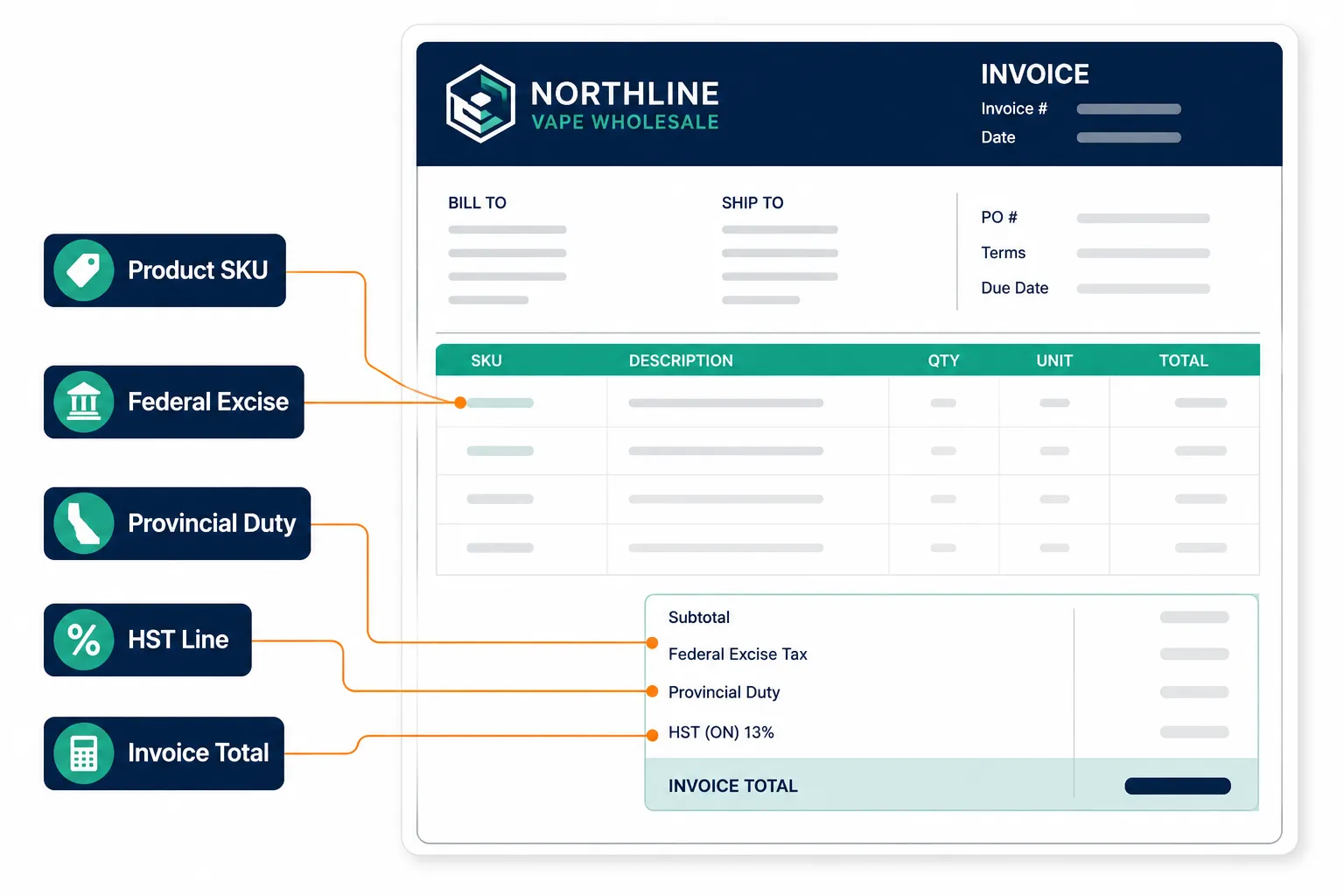
Standard line items include:
- Product description and SKU, the device name, flavour, nicotine strength, and e-liquid volume (in mL or grams).
- Quantity ordered, number of units per SKU.
- Unit price (pre-tax), the base cost per unit before any taxes or duties are added. Some invoices embed excise into this number; others break it out.
- Federal excise duty, shown per unit or as a lump sum per line. This should match the CRA’s published rate schedule based on the product’s liquid volume.
- Provincial vaping duty (if applicable), a separate line matching the federal duty amount, appearing only for products destined for specified provinces.
- GST or HST, calculated on the subtotal that includes the product price plus excise duties.
- Invoice total, the sum of all the above.
Some distributors also include the excise stamp serial numbers or a reference confirming that federal excise stamps are affixed to each unit. If excise duty is embedded in the unit price rather than broken out, request a duty breakdown. Without it, calculating real margins is guesswork.
Common mistake: Assuming the “unit price” on the invoice is your true product cost. If excise is embedded, the actual product cost (what the manufacturer charges before duty) could be a fraction of that number.
What Is Excise Tax on Vape Products and How Is It Calculated?
Canada’s federal vaping excise duty is a fixed-amount tax charged per unit of e-liquid volume, not a percentage of the sale price. It applies to all vaping products manufactured in or imported into Canada.
The current federal rates (effective July 1, 2024) are:
| Volume Bracket | Federal Rate | Combined Rate (Specified Province) |
|---|---|---|
| First 10 mL (or g): per 2 mL (or g) | $1.12 | $2.24 |
| Over 10 mL (or g): per 10 mL (or g) | $1.12 | $2.24 |
Calculation example for a 30 mL bottle in a specified province like Ontario:
- First 10 mL: 10 / 2 = 5 increments at $2.24 each = $11.20
- Remaining 20 mL: 20 / 10 = 2 increments at $2.24 each = $4.48
- Total combined excise = $15.68
That same 30 mL bottle in a non-specified province (like British Columbia) would carry only the federal portion: 5 x $1.12 + 2 x $1.12 = $7.84.
The duty is paid by the licensed manufacturer or importer at the point of packaging or importation. It then flows through the supply chain as a cost embedded in or added to the wholesale price. The rates represent a 12% increase over the original $1.00 structure introduced when the vaping excise framework launched.
Are All Vape Products Subject to the Same Excise Tax Rate?
No. The excise rate depends on the product’s liquid volume, not its type, brand, or nicotine strength. A 2 mL disposable pod and a 2 mL prefilled cartridge pay the same federal duty ($1.12 in a non-specified province, $2.24 in a specified one). But a 30 mL bottle of e-liquid pays far more in absolute terms because the duty scales with volume.
Key distinctions:
- Disposable vapes with small pods (2 mL): Pay the minimum duty bracket. In Ontario, that is $2.24 per device.
- Larger refill bottles (30 mL, 60 mL): Pay substantially more because the volume-based calculation compounds across both brackets.
- Nicotine-free vaping liquids: Still subject to excise duty if they are designed for use in a vaping device.
This volume-based structure is regressive relative to price. A budget 30 mL e-liquid priced at $15 wholesale loses a larger percentage of its value to excise ($15.68 in a specified province, which actually exceeds the product price) than a premium 30 mL bottle priced at $30. Retailers stocking lower-priced products need to be especially careful when evaluating wholesale disposable vape margins.
Difference Between GST and HST on Vape Wholesale Invoices
GST (Goods and Services Tax) is the 5% federal consumption tax. HST (Harmonized Sales Tax) combines the federal GST with a provincial component into a single rate. Which one appears on a vape wholesale invoice depends on the province where the sale takes place or where the goods are delivered.
Provincial tax rates on vape wholesale invoices:
| Province/Territory | Tax Type | Rate |
|---|---|---|
| Ontario | HST | 13% |
| New Brunswick | HST | 15% |
| Nova Scotia | HST | 15% |
| Prince Edward Island | HST | 15% |
| Newfoundland and Labrador | HST | 15% |
| Quebec | GST + QST | 5% + 9.975% |
| Alberta | GST only | 5% |
| British Columbia | GST + PST | 5% + 7% |
| Saskatchewan | GST + PST | 5% + 6% |
| Manitoba | GST + PST | 5% + 7% |
The critical detail for vape invoices: GST/HST is calculated on the price that already includes excise duty. So if a product costs $5.00 base plus $2.24 excise, the HST in Ontario (13%) applies to $7.24, not $5.00. That means the HST is $0.94 instead of $0.65, a difference that adds up across hundreds of units.
For retailers registered for GST/HST, the tax paid on wholesale purchases is recoverable as an Input Tax Credit (ITC). Excise duty, however, is not recoverable. This distinction matters enormously when calculating real cost of goods.
Why Is My Vape Wholesale Invoice Showing Different Tax Amounts?
Several legitimate reasons can cause tax amounts to vary between invoices, even from the same distributor.
Common causes:
- Mixed shipment destinations. If some products are destined for a specified province and others are not, the provincial vaping duty will differ between line items.
- Different product volumes. A 2 mL disposable and a 10 mL refill pod carry different excise amounts, so the tax base for GST/HST differs.
- Rate changes. If an invoice spans products packaged before and after a rate change (such as the July 1, 2024 increase), different excise rates may apply to different SKUs.
- Promotional pricing or volume discounts. Discounts reduce the base price but not the excise duty, which is fixed per volume. This changes the ratio of tax to product cost.
- Provincial tax differences. Distributors serving multiple provinces may show GST-only lines for Alberta shipments and HST lines for Ontario shipments on the same invoice.
Edge case: Some distributors embed excise into the unit price and show only GST/HST as a separate line. Others break out federal excise, provincial duty, and GST/HST individually. Both approaches are legal, but the second makes margin analysis much easier. When choosing a wholesale vape supplier, ask how they format their invoices before placing a first order.
How to Calculate Actual Profit Margin After Excise and Taxes on Vape
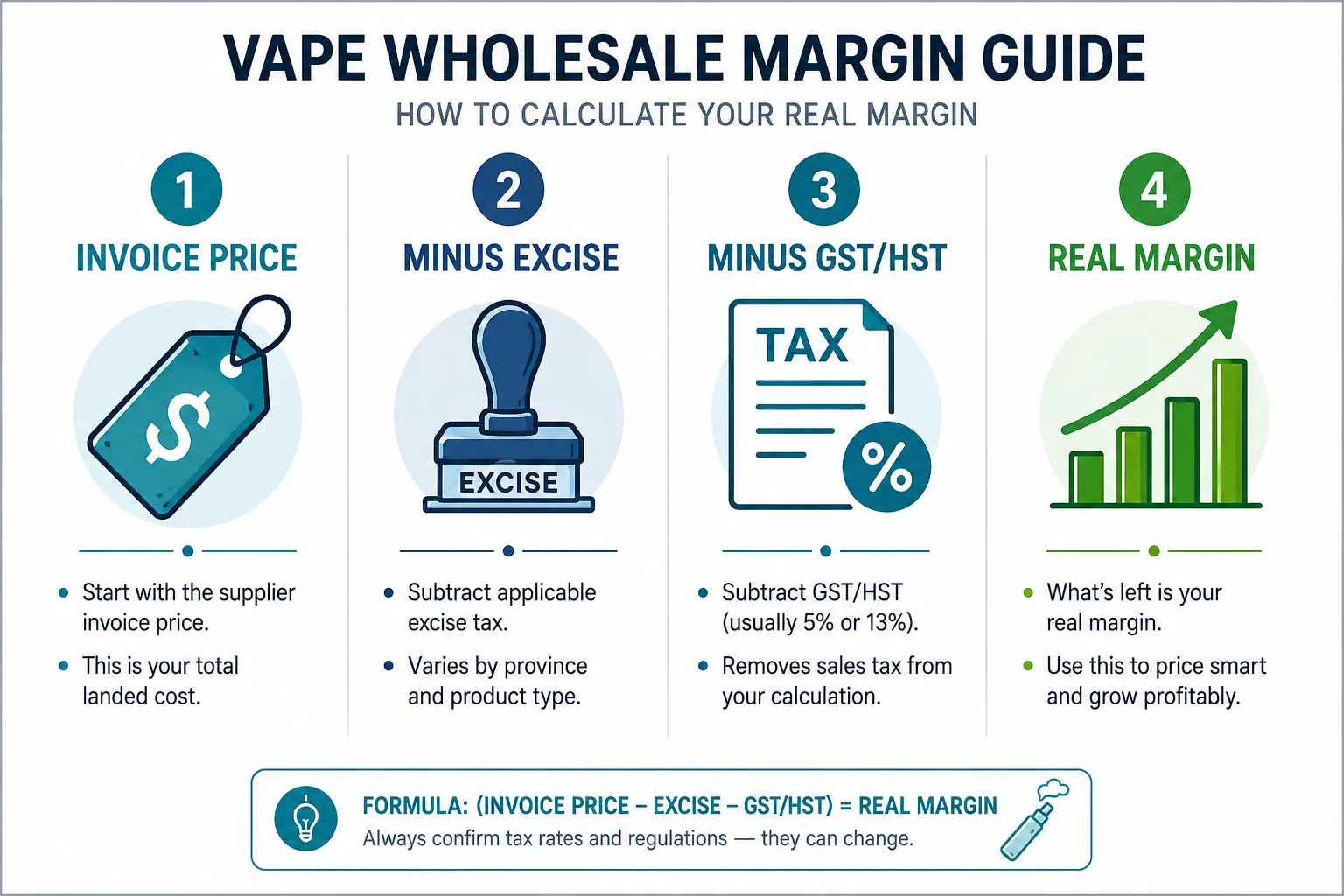
Real margin is what remains after subtracting the true landed cost (product cost plus non-recoverable excise) from the selling price, then accounting for the GST/HST you collect and remit. Here is the step-by-step process.
Step 1: Identify the base product cost. If excise is embedded in the unit price, ask the distributor for a breakdown. If the invoice shows excise separately, use the pre-excise unit price.
Step 2: Add non-recoverable excise duty. Federal excise plus provincial vaping duty (if in a specified province) cannot be claimed back. This is a hard cost.
Step 3: Add any non-recoverable provincial sales tax. In provinces with PST (like BC or Saskatchewan), PST paid on wholesale purchases may not be fully recoverable depending on the province’s rules. HST and GST are recoverable via ITCs for registered businesses.
Step 4: Calculate your landed cost per unit. Landed cost = base product cost + federal excise + provincial vaping duty + non-recoverable provincial tax + shipping per unit.
Step 5: Determine your retail selling price (tax-exclusive). This is the shelf price minus the GST/HST you collect from the consumer.
Step 6: Calculate real gross margin. Real gross margin = (tax-exclusive retail price – landed cost) / tax-exclusive retail price x 100.
Worked example for a 2 mL disposable vape in Ontario:
| Component | Amount |
|---|---|
| Base product cost (from distributor) | $3.50 |
| Federal excise (2 mL: 1 x $1.12) | $1.12 |
| Ontario provincial duty (1 x $1.12) | $1.12 |
| Shipping allocation per unit | $0.25 |
| Landed cost | $5.99 |
| Retail price (tax-inclusive) | $12.99 |
| HST collected (13%) | $1.49 |
| Tax-exclusive retail price | $11.50 |
| Real gross margin | $5.51 (47.9%) |
Without accounting for excise, the apparent margin on a $3.50 cost and $11.50 selling price would be 69.6%. The real margin of 47.9% is still workable, but significantly lower. For larger-volume products, the gap widens dramatically. Understanding these numbers is essential for anyone selling wholesale disposable vapes in Canada.
What’s the Difference Between Invoice Price and Actual Cost With Excise?
The invoice price is the number the distributor charges. The actual cost is the non-recoverable portion of that number plus any additional costs like shipping. These are not the same thing, and confusing them is the most common source of margin miscalculation in the vape wholesale business.
Invoice price typically includes:
- Base product cost
- Federal excise duty (embedded or itemized)
- Provincial vaping duty (embedded or itemized)
- GST/HST
Actual cost (for margin purposes) includes:
- Base product cost
- Federal excise duty (non-recoverable)
- Provincial vaping duty (non-recoverable)
- Shipping and handling
- Does NOT include GST/HST (recoverable via ITCs for registered businesses)
Decision rule: If you are GST/HST-registered, subtract the GST/HST from the invoice total to find your actual cost. If you are not registered (rare for wholesale buyers, but possible for very small operations), the GST/HST becomes part of your cost too.
How Does Excise Tax Affect Vape Retailer Pricing and Margins?
Excise duty compresses retail margins because it is a fixed cost per unit of volume that does not scale with the product’s price point. A $1.12 federal duty on a 2 mL pod represents 22.4% of a $5.00 wholesale product but only 11.2% of a $10.00 product. This creates structural pressure on lower-priced items.
Practical effects on retailer pricing:
- Floor pricing. Excise creates a minimum viable retail price below which no margin exists. For a 30 mL bottle in Ontario with $15.68 in combined excise, the retail price must exceed roughly $20 before any margin appears.
- Category shifts. Many retailers have moved toward smaller-volume products (like 2 mL disposables) where the absolute excise amount is lower, even though the per-mL rate is the same.
- Premium product advantage. Higher-priced products absorb excise more easily as a percentage of cost, making premium lines more attractive from a margin perspective.
- Competitive pressure. Retailers who do not understand excise mechanics may underprice products, thinking their margin is higher than it actually is.
The Department of Finance estimated that the 2024 rate increase added roughly 12 cents per typical pod in non-participating jurisdictions and 24 cents per pod in participating ones. That sounds small, but across thousands of units per month, it materially affects bottom-line profitability. Retailers looking to become a vape retailer in Ontario should model these costs before signing a lease.
Do I Pay Excise Tax as a Vape Retailer, or Does the Distributor?
Retailers do not remit excise duty directly to the CRA. The excise obligation falls on the licensed manufacturer or importer at the point of packaging or importation into Canada. However, the cost is passed through the supply chain and appears on the wholesale invoice as either a separate line item or embedded in the unit price.
What this means in practice:
- The distributor has already paid the excise (or it was paid by the manufacturer before the distributor received the goods).
- The retailer pays the excise indirectly through the wholesale price.
- The retailer cannot claim the excise back as a tax credit. It is a permanent cost of goods.
- Every legally sold vaping product must bear a federal excise stamp as proof that duty was paid.
Red flag: If a distributor offers vape products at prices that seem impossibly low, the excise may not have been paid. Products without valid excise stamps are illegal to sell in Canada and expose the retailer to enforcement action. Always verify that excise stamps are present and legitimate.
How to Read Wholesale Vape Invoices From Different Provinces in Canada
Reading a vape wholesale invoice varies by province because of two factors: whether the province is “specified” for vaping duty purposes, and which consumption tax regime applies.
Specified provinces (as of 2026): Ontario, Quebec, New Brunswick, Manitoba, Prince Edward Island, Alberta, Nova Scotia, Yukon, Northwest Territories, and Nunavut. These provinces participate in the coordinated vaping duty framework, so invoices for products sold here show both federal and provincial excise.
Non-specified provinces: British Columbia, Saskatchewan, and Newfoundland and Labrador. Invoices for these provinces show only federal excise duty.
Province-by-province invoice differences:
- Ontario invoice: Federal excise + provincial vaping duty + 13% HST on the excise-inclusive subtotal.
- Alberta invoice: Federal excise + provincial vaping duty + 5% GST only (no provincial sales tax component beyond the vaping duty).
- British Columbia invoice: Federal excise only (no provincial vaping duty) + 5% GST + 7% PST. The PST may or may not appear on the wholesale invoice depending on whether the distributor is a PST registrant.
- Quebec invoice: Federal excise + provincial vaping duty + 5% GST + 9.975% QST.
Practical tip: When comparing prices from vape wholesale suppliers in the GTA versus suppliers in other provinces, normalize all quotes to the same tax treatment. A lower sticker price from an Alberta distributor may not actually be cheaper once you account for the different consumption tax structure at the point of resale in Ontario.
How to Compare Vape Wholesale Prices Between Distributors Accounting for Taxes
The only valid way to compare wholesale prices is to strip every invoice down to the same base: the pre-excise, pre-tax product cost per unit, plus shipping.
Comparison checklist:
- Request itemized invoices from each distributor showing excise duty, provincial duty, and GST/HST as separate lines.
- Subtract all excise duties from the unit price to find the base product cost.
- Subtract GST/HST (since it is recoverable for registered businesses).
- Add shipping cost per unit. Divide total shipping by the number of units. Check whether any distributor offers free shipping thresholds that change the calculation at higher volumes.
- Compare the adjusted per-unit cost across distributors.
Example comparison:
| Factor | Distributor A | Distributor B |
|---|---|---|
| Invoice unit price | $8.50 | $7.80 |
| Federal excise (2 mL) | $1.12 | $1.12 |
| Provincial duty (Ontario) | $1.12 | $1.12 |
| HST (13%) | $0.96 | $0.88 |
| Shipping per unit | $0.30 | $0.55 |
| True product cost | $6.26 | $5.56 |
Distributor B looks cheaper on the invoice ($7.80 vs $8.50), and it is genuinely cheaper after normalization too ($5.56 vs $6.26). But if Distributor B had higher shipping, the result could flip. Always do the math.
Common Mistakes When Calculating Vape Wholesale Costs With Taxes
Miscalculating costs is widespread among new vape retailers. These are the errors that cause the most financial damage.
Mistake 1: Treating the invoice total as cost of goods. The invoice total includes recoverable GST/HST. Using it as your cost inflates your perceived expenses and may lead to overpricing that kills sales volume.
Mistake 2: Ignoring excise when setting retail prices. Setting a 50% markup on the invoice price without realizing that excise is already embedded means the actual markup on the product itself is much higher than intended, or worse, the margin is much thinner than expected.
Mistake 3: Using the same margin percentage across all product sizes. A flat 40% margin works differently on a 2 mL disposable (low absolute excise) versus a 30 mL bottle (high absolute excise). Margin percentages need to be set per product category.
Mistake 4: Forgetting that GST/HST applies to the excise-inclusive price. This is not a rounding error. On a $20 product with $15.68 in excise, the HST in Ontario is $4.64 instead of the $0.56 it would be on the $4.32 base product cost alone.
Mistake 5: Not verifying excise amounts against CRA rate schedules. Distributors can make errors. Cross-check the excise charged per SKU against the published rates based on the product’s liquid volume.
Mistake 6: Comparing distributor prices without normalizing for tax treatment. As covered above, raw invoice prices are meaningless for comparison without stripping out excise and consumption taxes.
What Happens If Excise Tax Rates Change Mid-Invoice Period?
When excise rates change (as they did on July 1, 2024, with the 12% increase), the applicable rate depends on when the product was packaged or entered the duty-paid market, not when it was invoiced or sold.
Transitional rules work as follows:
- Products packaged and stamped before the rate change date carry the old excise rate.
- Products packaged on or after the effective date carry the new rate.
- Distributors may have mixed inventory during a transition period, with some units at the old rate and others at the new rate.
- Invoices during transition periods should identify which rate applies to each line item.
What retailers should do:
- Ask distributors to confirm the excise rate applied to each SKU during any transition period.
- Do not assume all products on a single invoice carry the same excise rate.
- Adjust retail prices promptly when new-rate inventory arrives, or accept temporarily compressed margins on old-rate stock that was priced under the previous structure.
- Monitor CRA Excise Duty Notices (like EDN96, which covered the Budget 2024 changes) for official guidance on transitional treatment.
Industry communications from manufacturers and distributors in mid-2024 consistently warned that any pricing models based on the old $1.00 rate needed immediate updating. Retailers who delayed adjustments saw real margins shrink even though their nominal wholesale prices appeared unchanged.
Reading a Vape Wholesale Invoice: Excise, GST/HST, and Real Margins in Practice
Pulling everything together, here is a practical framework for reading any vape wholesale invoice that arrives in 2026.
Step-by-step invoice review process:
- Confirm the province designation. Is the destination a specified or non-specified province? This determines whether provincial vaping duty should appear.
- Check each SKU’s liquid volume. Match it against the excise calculation brackets.
- Verify excise amounts. Calculate what the excise should be using the CRA rate schedule and compare it to what is charged.
- Confirm the tax type. GST, HST, or GST + PST/QST should match the destination province.
- Verify the tax base. GST/HST should be calculated on the subtotal including excise, not on the base product price alone.
- Calculate your landed cost. Base product cost + excise + non-recoverable taxes + shipping.
- Model your retail price. Set a price that delivers your target margin after all non-recoverable costs.
Choose this approach if: You are ordering from a new distributor, receiving your first invoice after a rate change, or noticing unexpected totals on a recurring order.
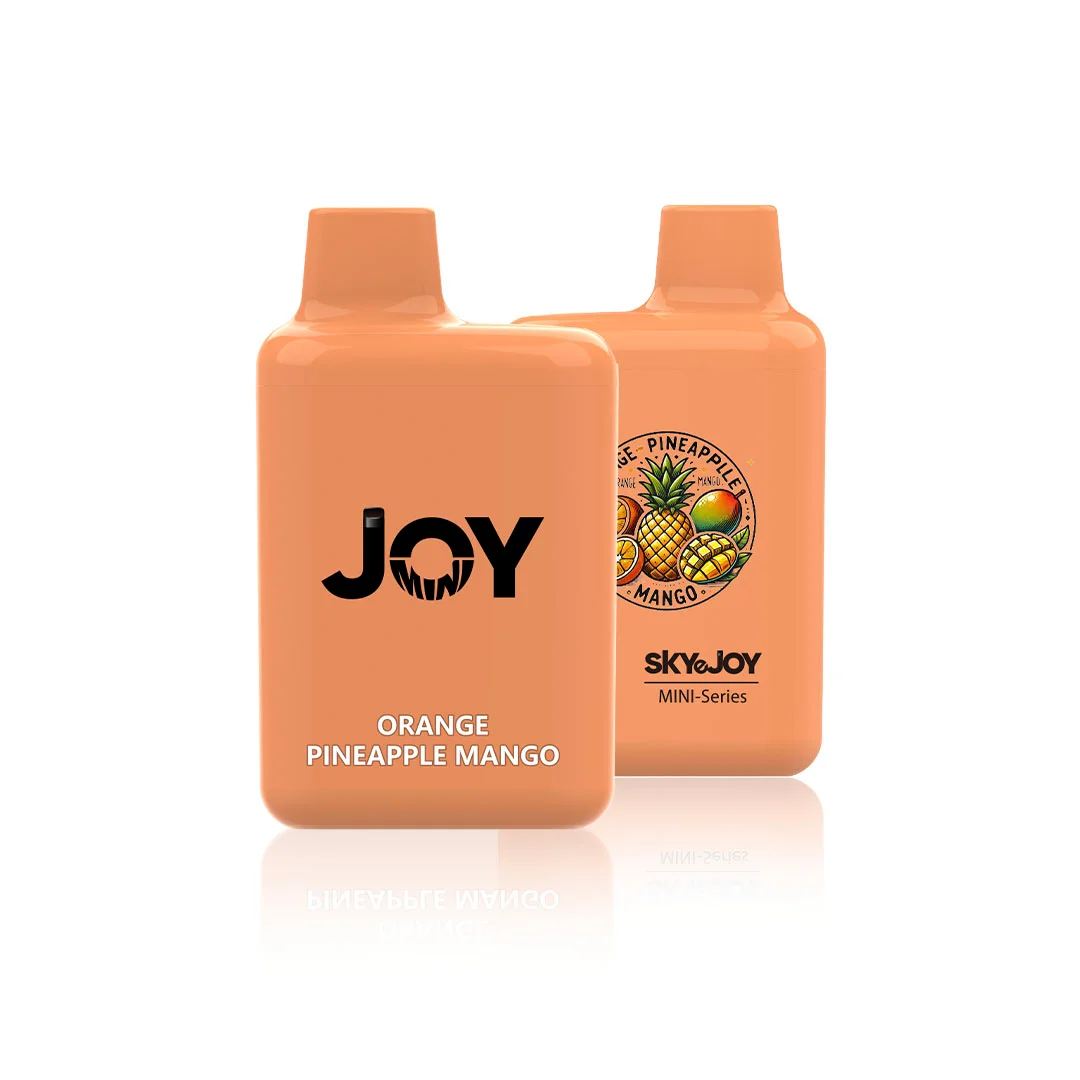
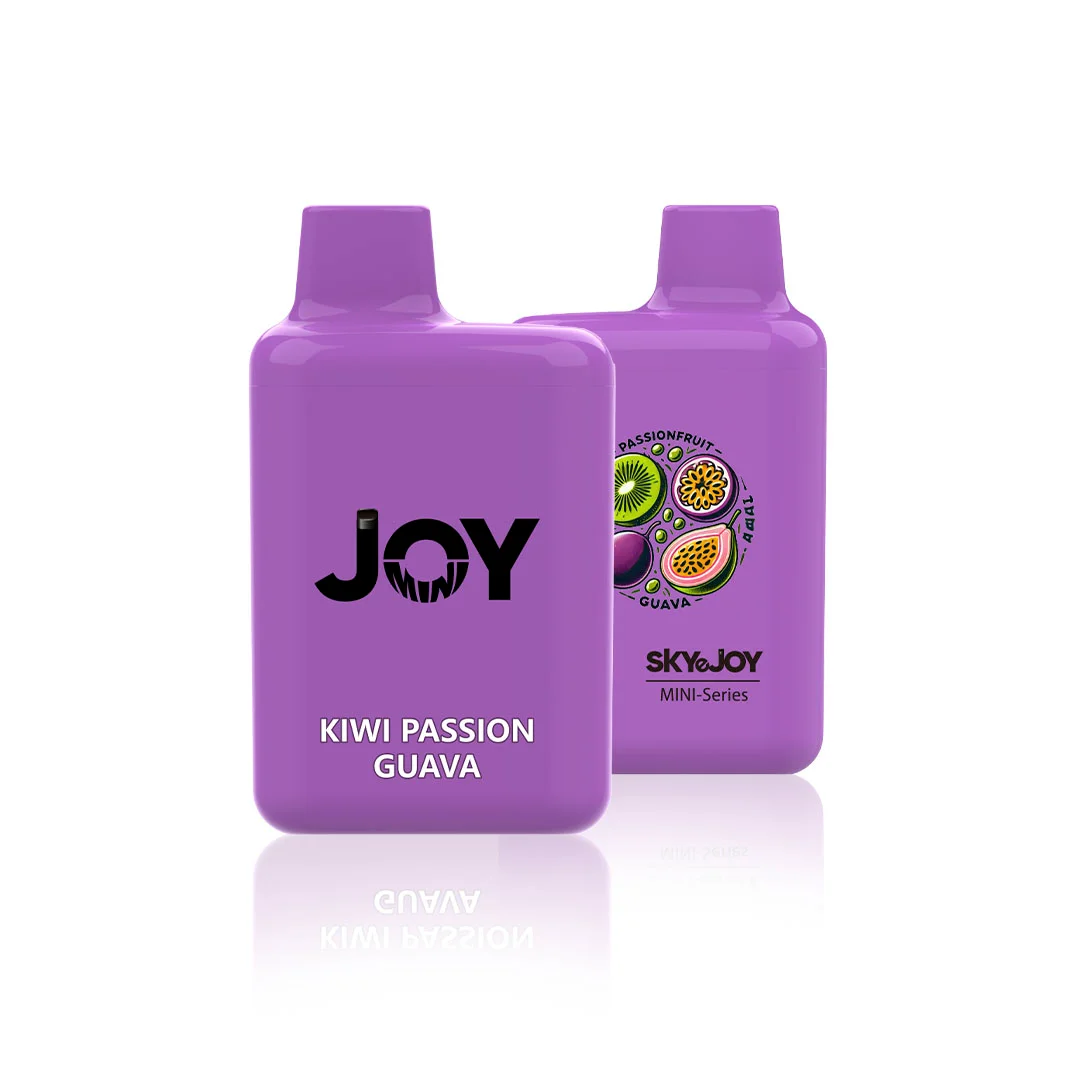
For Ontario retailers working with established suppliers, the Joy Mini wholesale program provides itemized invoicing that breaks out each cost component, making this review process straightforward.
Conclusion
Reading a vape wholesale invoice accurately is not optional, it is the foundation of profitable retail operations in Canada’s regulated vaping market. The interaction between volume-based excise duty, provincial vaping duty in specified provinces, and GST/HST calculated on the excise-inclusive price creates a layered cost structure that can mislead retailers who only look at the bottom-line invoice number.
Actionable next steps:
- Request itemized invoices from every distributor, with excise broken out from the base product cost.
- Build a spreadsheet that calculates real landed cost per SKU using the current CRA rate schedule.
- Set retail prices based on real margins, not apparent margins from the raw invoice price.
- Re-run margin calculations whenever excise rates change or you switch provinces or suppliers.
- Verify excise stamps on every shipment to confirm duty compliance.
- Review CRA Excise Duty Notices periodically for rate updates and transitional rules.
Margins in the vape wholesale business are real, but only for retailers who understand exactly where every dollar on their invoice goes.
Frequently Asked Questions
What is the current federal excise duty rate on vaping products in Canada? The federal rate is $1.12 per 2 mL (or gram) for the first 10 mL of liquid, and $1.12 per 10 mL for any volume above 10 mL. These rates took effect July 1, 2024.
Do all Canadian provinces charge provincial vaping duty? No. Only specified provinces participate in the coordinated framework. As of 2026, these include Ontario, Quebec, Alberta, Manitoba, New Brunswick, PEI, Nova Scotia, Yukon, NWT, and Nunavut. British Columbia, Saskatchewan, and Newfoundland and Labrador are non-specified.
Can I claim back the excise duty on my tax return? No. Excise duty on vaping products is not recoverable. It is a permanent cost of goods for retailers. GST/HST, by contrast, is recoverable through Input Tax Credits if you are a registered business.
Why does my invoice show more tax than I expected? GST/HST is calculated on the price that includes excise duty. This means the tax base is higher than the base product cost alone, resulting in a larger tax amount than many retailers anticipate.
How do I know if excise duty was actually paid on the products I’m buying? Every legally sold vaping product in Canada must carry a federal excise stamp. Check each unit for the stamp. Products without stamps may be illicit and expose you to legal liability.
Is excise duty the same on disposable vapes and refill bottles? The per-mL rate is the same, but the total duty differs because it is based on liquid volume. A 2 mL disposable pays much less in absolute terms than a 30 mL refill bottle.
How often do excise rates change? Rate changes are announced in federal budgets and implemented through legislation. The most recent change was the 12% increase effective July 1, 2024, announced in Budget 2024. There is no fixed schedule for future changes.
Should I adjust my retail prices every time excise rates change? Yes. Because excise is a fixed cost per unit of volume, any rate increase directly reduces your margin unless you adjust retail prices accordingly.
What if my distributor does not itemize excise on the invoice? Request an itemized breakdown. If the distributor cannot or will not provide one, consider switching to a supplier that offers transparent invoicing. You cannot manage margins on costs you cannot see.
Does the excise apply to nicotine-free vape liquids? Yes. The excise duty applies to all vaping substances designed for use in a vaping device, regardless of whether they contain nicotine.
How do I handle invoices with products at different excise rates during a transition? Ask the distributor to identify which rate applies to each SKU. Products packaged before a rate change carry the old rate; products packaged after carry the new rate. Do not assume a single rate applies to the entire invoice.
Is it legal to buy vape products from distributors in other provinces? Yes, but the applicable excise (specified vs. non-specified provincial duty) and consumption tax will depend on the destination province, not the distributor’s location. Ensure the invoice reflects the correct tax treatment for where you will sell the products.