









Last updated: June 24, 2026
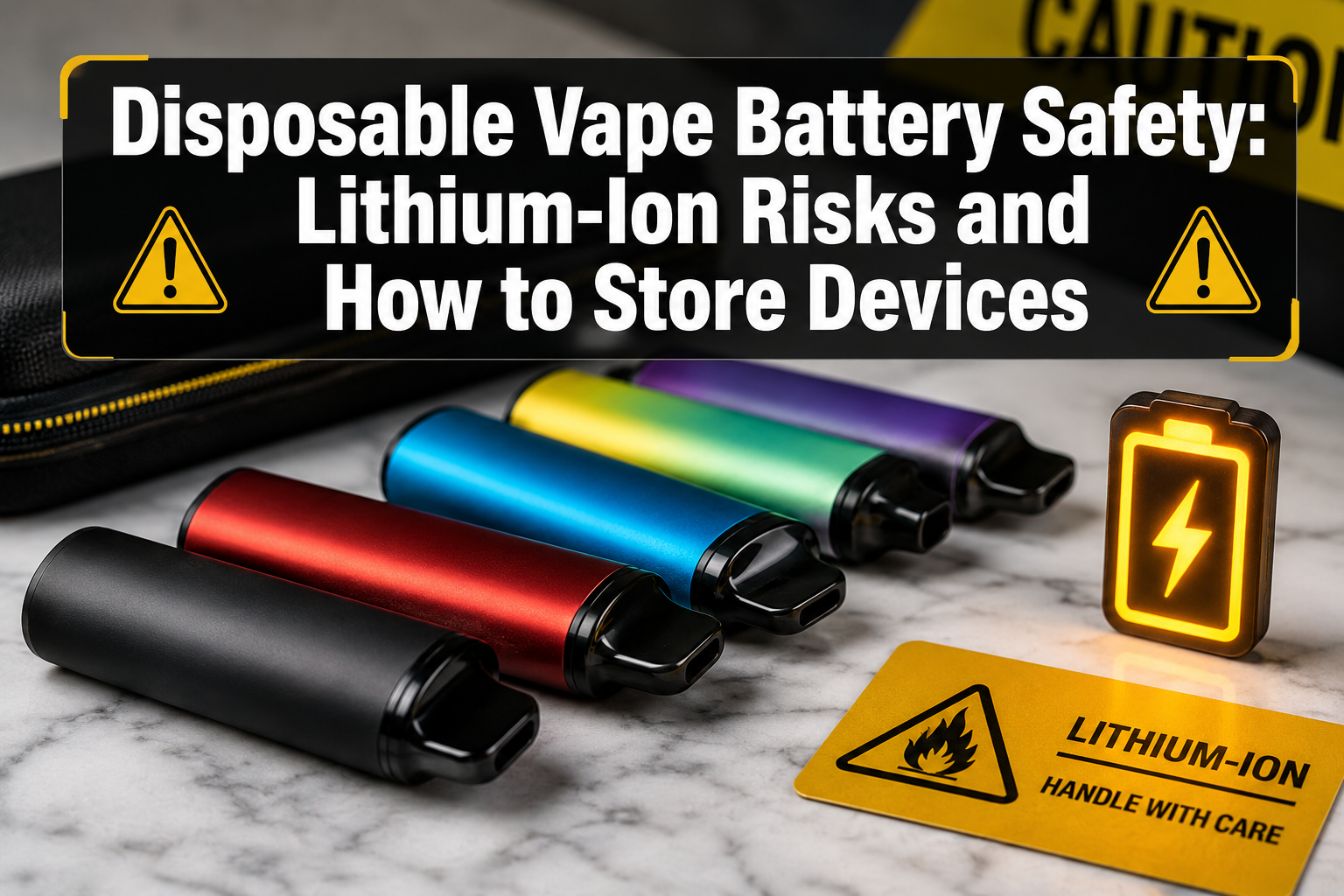
Quick Answer: Every disposable vape contains a small lithium-ion battery that can overheat, swell, or catch fire if mishandled, stored in extreme temperatures, or physically damaged. Safe use comes down to three basics: buy from reputable sources, store devices at room temperature away from direct sunlight, and never throw them in regular trash. Understanding disposable vape battery safety, lithium-ion risks, and how to store devices properly takes just a few minutes and can prevent serious incidents.
Key Takeaways
- Lithium-ion batteries inside disposable vapes can experience “thermal runaway,” a chain reaction that leads to fire or explosion, if damaged or exposed to extreme heat.
- Over 1,200 fire incidents in a single year in the UK have been linked to improperly handled disposable vape batteries.
- Never leave a disposable vape in a hot car, direct sunlight, or near other heat sources. Ideal storage temperature is between 15 and 25 degrees Celsius (59 to 77 degrees Fahrenheit).
- Counterfeit and unregulated disposable vapes often lack basic battery safety features, making them far more dangerous than products from licensed retailers.
- Physical damage like drops, crushing, or punctures can compromise the battery’s internal separator and cause a short circuit.
- Rechargeable disposable vapes should only be charged with the cable provided, on a flat non-flammable surface, and never left plugged in overnight.
- Airlines require disposable vapes in carry-on luggage only, never in checked bags, due to lithium-ion battery fire risk.
- Disposable vapes belong at e-waste recycling drop-offs, not in household garbage or recycling bins.
- Inspecting a device for dents, unusual warmth, hissing sounds, or a chemical smell before use can catch problems early.
- Buying from reputable Canadian vape retailers that carry products with federal excise stamps reduces counterfeit risk significantly.
What Makes Lithium-Ion Batteries in Disposable Vapes Risky?
Lithium-ion batteries are energy-dense, which is exactly why they power everything from smartphones to disposable vapes. But that same energy density is what makes them dangerous when something goes wrong.
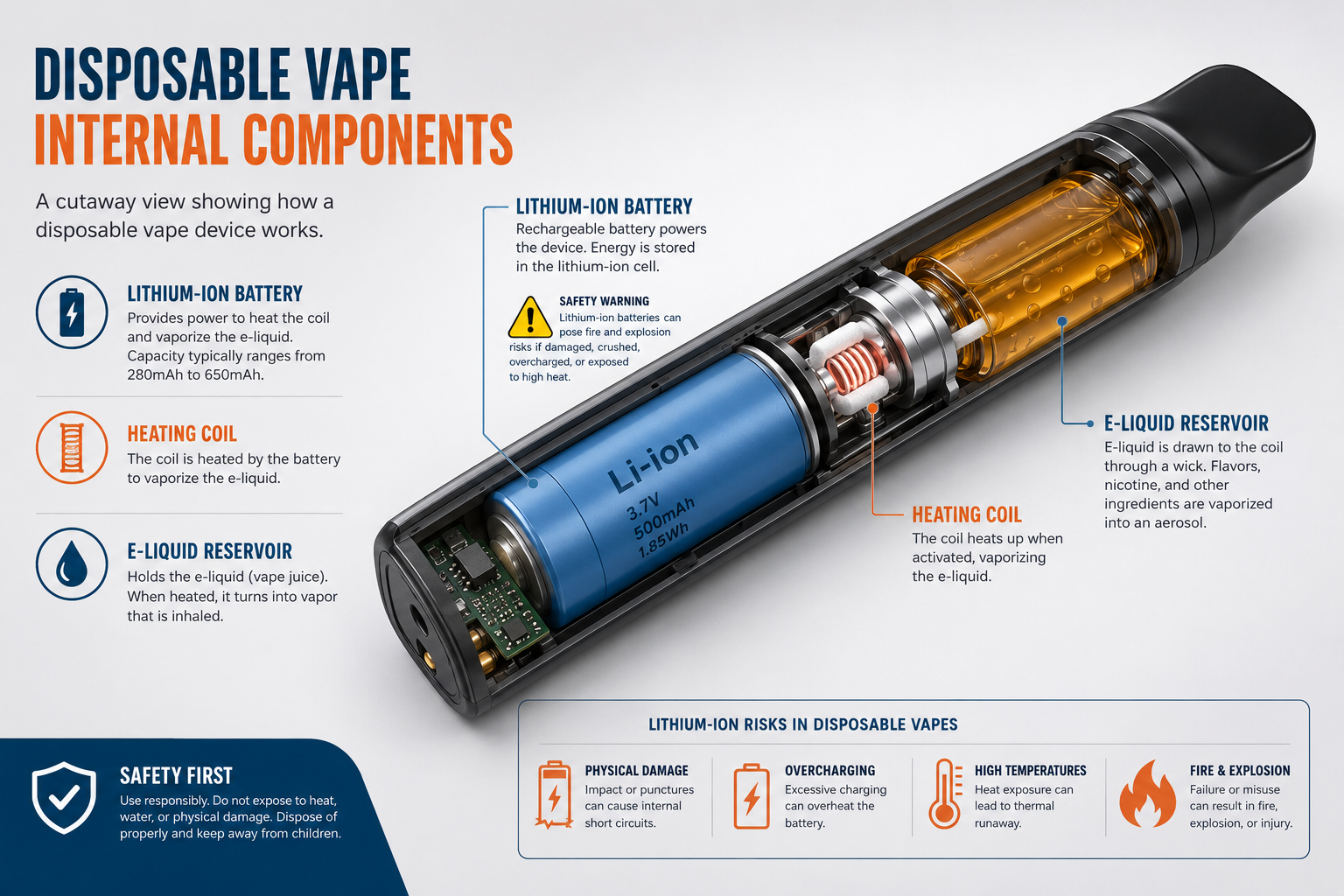
Inside a disposable vape, a small lithium-ion cell (typically between 400 mAh and 900 mAh) sits alongside the heating coil and e-liquid reservoir. The battery’s internal structure relies on a thin separator between the positive and negative electrodes. If that separator is breached through physical damage, manufacturing defects, or excessive heat, the electrodes can make contact and trigger a short circuit.
That short circuit can lead to thermal runaway: a self-accelerating chemical reaction where the battery’s temperature climbs rapidly, potentially reaching over 500 degrees Celsius. At that point, the battery can vent hot gas, catch fire, or in rare cases, explode.
Key risk factors include:
- Physical damage (drops, sitting on the device, punctures)
- Exposure to temperatures above 45 degrees Celsius (113 degrees Fahrenheit)
- Manufacturing defects, especially common in counterfeit products
- Water exposure that corrodes internal connections
- Overcharging in rechargeable disposable models
For a deeper look at how the battery, coil, and e-liquid work together, see this guide on how disposable vapes work.
Common mistake: Many users assume that because a disposable vape is small, its battery is too small to cause harm. Even a 500 mAh lithium-ion cell contains enough energy to start a fire that can destroy a room.
How Can You Tell If a Disposable Vape Battery Is Failing?
A failing lithium-ion battery almost always gives warning signs before a serious incident. Recognizing these signs early is the simplest form of disposable vape battery safety.
Stop using the device immediately if you notice any of these:
| Warning Sign | What It Means |
|---|---|
| Device feels unusually hot during use or while idle | Internal short circuit or chemical breakdown may be starting |
| Swelling or bulging of the device casing | Gas buildup inside the battery cell, a precursor to venting |
| Hissing or crackling sounds (not from the coil) | Electrolyte leaking or pressure building inside the cell |
| Chemical or sweet solvent smell from the device body | Battery electrolyte is leaking |
| Device activates on its own without a puff | Sensor malfunction or internal short, both fire risks |
| Visible dents, cracks, or deformation | Physical damage may have compromised the battery separator |
Edge case: A device that was working fine but got submerged in water (dropped in a puddle, left in rain) should be discarded even if it still powers on. Water can cause slow corrosion that leads to a delayed short circuit days later.
If a device shows any of these symptoms, place it on a non-flammable surface away from people and materials, let it cool, and bring it to an e-waste collection point. Do not put it in a garbage bin.
How Should You Store Disposable Vapes Safely?
Store disposable vapes in a cool, dry place at room temperature, between 15 and 25 degrees Celsius, away from direct sunlight and heat sources. This single habit prevents most battery-related incidents.
Storage dos and don’ts:
Do:
- Keep devices upright in a drawer, cabinet, or case at room temperature
- Store away from metal objects like keys, coins, or loose screws that could contact the charging port or terminals
- Keep out of reach of children and pets
- Check stored devices periodically for swelling or damage
Don’t:
- Leave in a parked car (interior temperatures can exceed 60 degrees Celsius in summer)
- Store in direct sunlight on a windowsill or dashboard
- Keep in a pocket with keys, coins, or other metal objects
- Place near radiators, stoves, or other heat sources
- Store in freezing conditions below minus 10 degrees Celsius (14 degrees Fahrenheit), which can damage the battery chemistry
Decision rule: If you wouldn’t leave a smartphone in that spot for hours, don’t leave a disposable vape there either. The same lithium-ion chemistry applies.
For Canadian vapers who stock up, proper storage matters even more when buying in bulk. Learning about common buying mistakes first-time users make can help avoid ending up with devices that degrade before they’re used.
Are Rechargeable Disposable Vapes More Dangerous Than Non-Rechargeable Ones?
Rechargeable disposable vapes carry an additional risk that non-rechargeable models don’t: overcharging. But both types contain the same fundamental lithium-ion hazard.
Non-rechargeable disposables are designed to discharge once and be discarded. Their batteries are sealed and cannot be plugged in, which eliminates charging-related risks. However, they’re still vulnerable to heat exposure, physical damage, and manufacturing defects.
Rechargeable disposables add a USB-C charging port and associated circuitry. This introduces several extra risk points:
- Using the wrong charger: Third-party cables or high-wattage chargers designed for phones can deliver more current than the vape’s battery management system can handle.
- Overcharging: Leaving a device plugged in for hours (or overnight) can degrade the battery and cause heat buildup, especially if the device lacks overcharge protection.
- Charging on flammable surfaces: Charging on a bed, couch, or pile of papers creates a fire risk if the battery vents.
Safe charging checklist:
- Use only the cable that came with the device.
- Charge on a flat, hard, non-flammable surface (a kitchen counter or desk).
- Stay in the room while charging. Unplug once the indicator shows full.
- Never charge overnight or while sleeping.
- Do not charge a device that is visibly damaged, wet, or unusually warm.
The FDA specifically advises charging on a clean, flat surface away from anything that can catch fire and never leaving devices charging unattended.
To understand the differences between disposable and refillable options, check out this comparison of disposable vapes vs. pod systems.
Why Are Counterfeit Disposable Vapes a Bigger Battery Risk?
Counterfeit disposable vapes are significantly more dangerous because they routinely skip the safety features that prevent battery failures.
Legitimate manufacturers include battery management systems (BMS) that monitor voltage, prevent overcharging, and shut down the device if it overheats. Counterfeit products often lack these protections entirely. Their batteries may be recycled from other electronics, improperly rated for the device’s power draw, or assembled without quality control.
How to spot a counterfeit:
- Missing or incorrect federal excise stamps (required on all legal vape products sold in Canada)
- Misspelled brand names or inconsistent packaging
- Unusually low prices compared to authorized retailers
- No batch number, manufacturing date, or regulatory markings
- Purchased from unlicensed sellers, social media, or informal markets
The safest approach: Buy from licensed Canadian retailers who carry products with proper excise stamps and can verify their supply chain. This doesn’t eliminate all risk, but it dramatically reduces the chance of getting a device with a defective battery.
What Are the Rules for Traveling With Disposable Vapes?
The Federal Aviation Administration (FAA) requires all electronic smoking devices, including disposable vapes, to be carried in your person or in carry-on baggage. They are banned from checked luggage.
This rule exists because lithium-ion battery fires in the cargo hold are extremely difficult for crew to detect and extinguish. In carry-on bags or on your person, a thermal event can be spotted and managed quickly.
Air travel rules for disposable vapes:
- Carry-on only. Never pack in checked bags.
- Prevent accidental activation. Keep the device in its original packaging or a protective case. Some airlines recommend placing tape over the mouthpiece or any activation button.
- No charging on the aircraft. Plugging in a rechargeable disposable vape during a flight is prohibited.
- Spare lithium batteries (if carrying any for other devices) must also be in carry-on and individually protected against short circuits.
- No use during the flight. Vaping on commercial aircraft is illegal in Canada and the United States.
Quick tip for Canadian travelers: Familiarize yourself with where you can and cannot vape in Ontario and similar provincial rules before your trip, so you know the regulations at your destination too.
How Should You Dispose of Disposable Vapes?
Never throw a disposable vape in household garbage or recycling. The lithium-ion battery inside can be crushed or punctured during waste processing, causing fires in garbage trucks and recycling facilities.
An estimated 5 million disposable vapes are discarded weekly in the UK alone, and many end up in general waste streams. Canada faces a similar challenge. Fires at waste management facilities linked to lithium-ion batteries from consumer electronics, including vapes, have been increasing year over year.
Proper disposal steps:
- Use up the device or determine it’s no longer functional. Learn how to tell when a disposable vape is near the end so you’re not discarding devices with significant charge remaining.
- Do not attempt to disassemble the device to remove the battery. This risks puncturing the cell.
- Locate a battery recycling or e-waste drop-off in your area. In Ontario, many municipalities have household hazardous waste depots that accept lithium-ion batteries. Retailers like some electronics stores also accept them.
- If the device is damaged or swelling, place it in a non-flammable container (like a metal tin) with sand or dry cat litter and bring it to a hazardous waste facility. Do not leave it in your home unattended.
- Never put disposable vapes in a fire. The battery can explode violently.
For retailers and wholesalers: If you’re selling disposable vapes in Canada, consider offering a take-back program. It builds customer loyalty and reduces liability from improper disposal.
What Happens If a Disposable Vape Gets Wet?
Water and lithium-ion batteries are a bad combination. Moisture can corrode the battery terminals, damage the internal circuitry, and create conductive pathways that lead to short circuits.
If a disposable vape gets wet:
- Do not attempt to use it. Even if it seems to work, internal corrosion may be progressing.
- Do not try to dry it with a hair dryer or heat source. Adding heat to a potentially compromised battery increases the risk of thermal runaway.
- Place it on a non-flammable surface and allow it to air dry at room temperature for observation.
- Dispose of it properly at an e-waste collection point. Do not put it in regular trash.
Edge case: Brief contact with rain or a small splash is less risky than full submersion, but the safe choice is still to retire the device. A replacement disposable vape costs far less than dealing with a battery fire.
Can Extreme Cold Damage Disposable Vape Batteries?
Yes. While extreme heat gets more attention, cold temperatures also affect lithium-ion battery safety and performance.
Below 0 degrees Celsius (32 degrees Fahrenheit), lithium-ion batteries lose capacity and deliver less power. The e-liquid also thickens, which can cause the coil to work harder and draw more current than normal. Below minus 20 degrees Celsius (minus 4 degrees Fahrenheit), attempting to use or charge a lithium-ion battery can cause lithium plating on the anode, permanently damaging the cell and creating internal short-circuit risks.
For Canadian winters specifically:
- Don’t leave disposable vapes in an unheated car overnight.
- Keep the device in an inside jacket pocket close to your body when outdoors.
- Allow a cold device to warm to room temperature before using it.
- If a device was exposed to extreme cold for an extended period, inspect it for any condensation before use.
This is especially relevant for vapers across Ontario and other provinces where winter temperatures regularly drop well below freezing. For a broader look at choosing devices suited to Canadian conditions, see this guide on how to choose the right disposable vape.
Disposable Vape Battery Safety Checklist
Use this quick reference before and during device use:
| Action | When | Why |
|---|---|---|
| Inspect for dents, swelling, or cracks | Before first use and periodically | Catches physical damage before it causes a failure |
| Verify excise stamp and packaging authenticity | At purchase | Confirms the product meets Canadian safety standards |
| Store between 15 and 25 degrees Celsius | Always | Prevents heat-related battery degradation |
| Keep away from metal objects | During storage and transport | Prevents accidental short circuits |
| Use only the provided charging cable | When charging rechargeable models | Prevents overcurrent and overcharging |
| Charge on a hard, non-flammable surface | Every charge session | Contains any potential thermal event |
| Never leave charging unattended | Every charge session | Allows immediate response if something goes wrong |
| Dispose at e-waste collection point | When device is empty or damaged | Prevents fires in waste facilities and landfills |
| Carry in carry-on bag during flights | Every flight | Required by aviation regulations |
| Stop using if device is hot, hissing, or smells chemical | Immediately upon detection | These are precursors to thermal runaway |
Frequently Asked Questions
Can a disposable vape explode in your pocket? It’s rare but possible. If the device is physically damaged (sat on, crushed, or punctured by keys or coins), the battery can short-circuit and vent hot gas or flame. Keep devices in a separate pocket or case, away from metal objects.
Is it safe to leave a disposable vape in a hot car? No. Car interiors can exceed 60 degrees Celsius in summer. At these temperatures, lithium-ion batteries can swell, leak, or enter thermal runaway. Always take your vape with you when leaving the vehicle.
How long can you store a disposable vape before using it? Most disposable vapes have a shelf life of about 12 to 18 months when stored properly at room temperature. Over time, the e-liquid can degrade and the battery can slowly discharge. Check the expiration or manufacturing date if printed on the packaging.
What should you do if a disposable vape starts smoking on its own? Move away from the device immediately. Do not touch it with bare hands if it’s hot. Place it on a non-flammable surface (concrete, metal tray) and let it vent completely. Call emergency services if a fire starts. Do not attempt to extinguish a lithium-ion battery fire with water; use a dry chemical or CO2 extinguisher if available.
Can you recycle disposable vapes in regular recycling bins? No. The lithium-ion battery makes them hazardous waste. Regular recycling facilities are not equipped to handle them, and the batteries can cause fires during processing. Use dedicated e-waste or battery recycling drop-offs.
Do disposable vapes have built-in safety features? Legitimate products from reputable manufacturers typically include short-circuit protection, over-discharge protection, and sometimes overcharge protection (in rechargeable models). Counterfeit products often lack some or all of these features.
Is it dangerous to use a disposable vape while it’s charging? Yes. Using a device while charging (called “pass-through” use) increases heat generation in both the battery and the coil simultaneously. Unless the manufacturer explicitly states the device supports pass-through charging, avoid it.
Can cold weather make a disposable vape battery explode? Extreme cold alone is unlikely to cause an explosion, but it can damage the battery internally. Using or charging a deeply frozen lithium-ion battery can cause lithium plating, which creates long-term short-circuit risks. Let a cold device warm up before use.
How do you safely transport multiple disposable vapes? Keep each device in its original packaging or separated by non-conductive material (paper, cardboard dividers). Do not let devices touch each other or contact metal objects. For air travel, all devices must be in carry-on luggage.
Are bigger disposable vapes with higher puff counts more dangerous? Higher puff-count devices typically have larger batteries (up to 900 mAh or more), which means more stored energy. The fundamental safety rules are the same, but the consequences of a failure can be more severe with a larger cell. Understanding what different puff counts really mean helps set realistic expectations.
Conclusion
Disposable vape battery safety comes down to a handful of practical habits. Store devices at room temperature, away from sunlight and heat. Inspect them before use for physical damage. Buy only from licensed retailers carrying products with valid excise stamps. Charge rechargeable models on hard surfaces with the correct cable, and never leave them unattended. When a device is done, take it to an e-waste drop-off instead of tossing it in the trash.
Lithium-ion batteries are safe when treated correctly, but they don’t forgive neglect. The risks are real: thermal runaway, fire, and chemical burns. The good news is that every one of these risks is preventable with basic awareness.
Your next steps:
- Check your current storage setup. Are any devices sitting in direct sunlight, in a hot car, or loose in a bag with metal objects? Fix that today.
- Locate your nearest e-waste or battery recycling drop-off for when devices reach end of life.
- If you’re buying disposable vapes, verify the federal excise stamp on every product to confirm it’s legitimate.
- Share this information with anyone else who uses disposable vapes. Battery safety is only effective when everyone handling the device knows the basics.
SEO Meta Title: Disposable Vape Battery Safety: Lithium-Ion Risks and Storage Tips
SEO Meta Description: Learn disposable vape battery safety in 2026, including lithium-ion risks, proper storage, charging tips, travel rules, and safe disposal practices for Canadian vapers.