





Last updated: June 16, 2026
Quick Answer: The Smoke-Free Ontario Act (SFOA), 2017, treats vaping almost identically to smoking in most public spaces across Ontario. In 2026, proposed amendments under Bill 125 would raise the minimum purchase age to 21, ban most flavoured vape products, restrict sales to specialty stores, and prohibit online vape sales. Whether these amendments pass or not, existing SFOA rules already ban vaping in enclosed public places, enclosed workplaces, and many outdoor areas — with fines starting at $1,000 for individuals.
Key Takeaways
- The SFOA, 2017 already prohibits vaping everywhere smoking is banned, including enclosed workplaces, restaurant patios, and within 9 metres of building entrances.
- Bill 125 (introduced in 2026) proposes raising Ontario’s minimum vape purchase age from 19 to 21.
- The same bill would ban all flavoured vape products except tobacco-flavoured ones.
- Online sales of vape products would be prohibited under Bill 125 if passed.
- Fines for individuals caught vaping in prohibited areas range from $1,000 to $5,000; corporations face up to $100,000.
- Vaping in a private apartment is generally legal, but landlords can restrict it through lease terms.
- Cannabis vapes fall under both the SFOA and the Cannabis Act, 2017, with overlapping restrictions.
- Schools and universities enforce vaping bans on all property, and students face disciplinary action on top of potential fines.
- Public Health Units handle enforcement, conducting inspections and responding to complaints.
- Retailers must keep vape products hidden from view and cannot promote them where consumers can handle them before purchase.
What Exactly Does the Smoke-Free Ontario Act Mean for Vaping in Ontario
The Smoke-Free Ontario Act, 2017 (SFOA) regulates vaping in the same way it regulates tobacco smoking across most settings. If a location bans smoking, it bans vaping too. This applies to enclosed public spaces, enclosed workplaces, and a growing list of outdoor areas.
Beyond the existing law, Bill 125 — titled the Smoke-Free Ontario Amendment Act (Vaping is not for Kids) — was introduced in 2026 and proposes several major changes:
- Age increase: The minimum purchase age for tobacco and vape products would rise from 19 to 21.
- Flavour ban: All flavoured vape products would be prohibited except those with tobacco flavouring.
- Nicotine limits: Sales of vape products above specified nicotine thresholds would be restricted (Canada already enforces a 20 mg/mL nicotine cap at the federal level).
- Retail restrictions: Vape products could only be sold in specialty vape stores or approved stores in remote/rural communities, with local health board oversight.
- Online sales ban: Internet sales of vape products would be prohibited entirely.
- Tax revenue for education: Revenue from vape product taxes could be directed toward public health education campaigns.
- Annual youth vaping report: Ontario Health would be required to publish yearly data and recommendations on youth vaping.
Bill 125 is proposed legislation, meaning it hasn’t become law yet. But the existing SFOA rules are fully enforceable right now. For a broader overview of current regulations, see the complete guide to vaping laws in Ontario for adults 19+.
Where Am I Allowed to Vape Under These New Rules
Under the SFOA, vaping is permitted in private residences (with some landlord exceptions), on public sidewalks that aren’t within restricted buffer zones, and inside specialty vape shops that may have designated testing areas. Everywhere else requires careful attention to the rules.
Places where vaping IS generally allowed:
- Inside your own home or on your own private property
- On public sidewalks, as long as you’re more than 9 metres from entrances and exits of enclosed public spaces and workplaces
- In some designated hotel/motel rooms (where the establishment permits it)
- Inside your personal vehicle (though not while driving with minors present)
Places where vaping is NOT allowed:
- Any enclosed public space (malls, arenas, community centres, libraries)
- Any enclosed workplace
- Restaurant and bar patios
- Within 9 metres of entrances, exits, and air intakes of enclosed public spaces
- Public transit vehicles, shelters, and platforms
- School grounds and surrounding areas
- Playgrounds and sports fields
- Hospital grounds and health care facilities
- Government buildings
For a detailed breakdown of buffer zones and specific locations, check out where you can and cannot vape in Ontario, including the 9-metre rule.
Which Public Spaces Completely Ban Vaping Now
All enclosed public spaces in Ontario completely ban vaping, with no exceptions. This includes shopping centres, movie theatres, concert venues, museums, fitness centres, and any indoor area open to the public.
Outdoor public spaces with complete vaping bans include:
- Playgrounds and splash pads — vaping is banned on the entire grounds
- Sports fields and spectator areas — both recreational and organized sport venues
- Restaurant and bar patios — even if they’re open-air
- Public transit areas — buses, streetcars, subway platforms, and shelters
- Hospital and health care facility grounds — the entire property, not just indoors
- Children’s recreation areas — day camps, community centre outdoor spaces
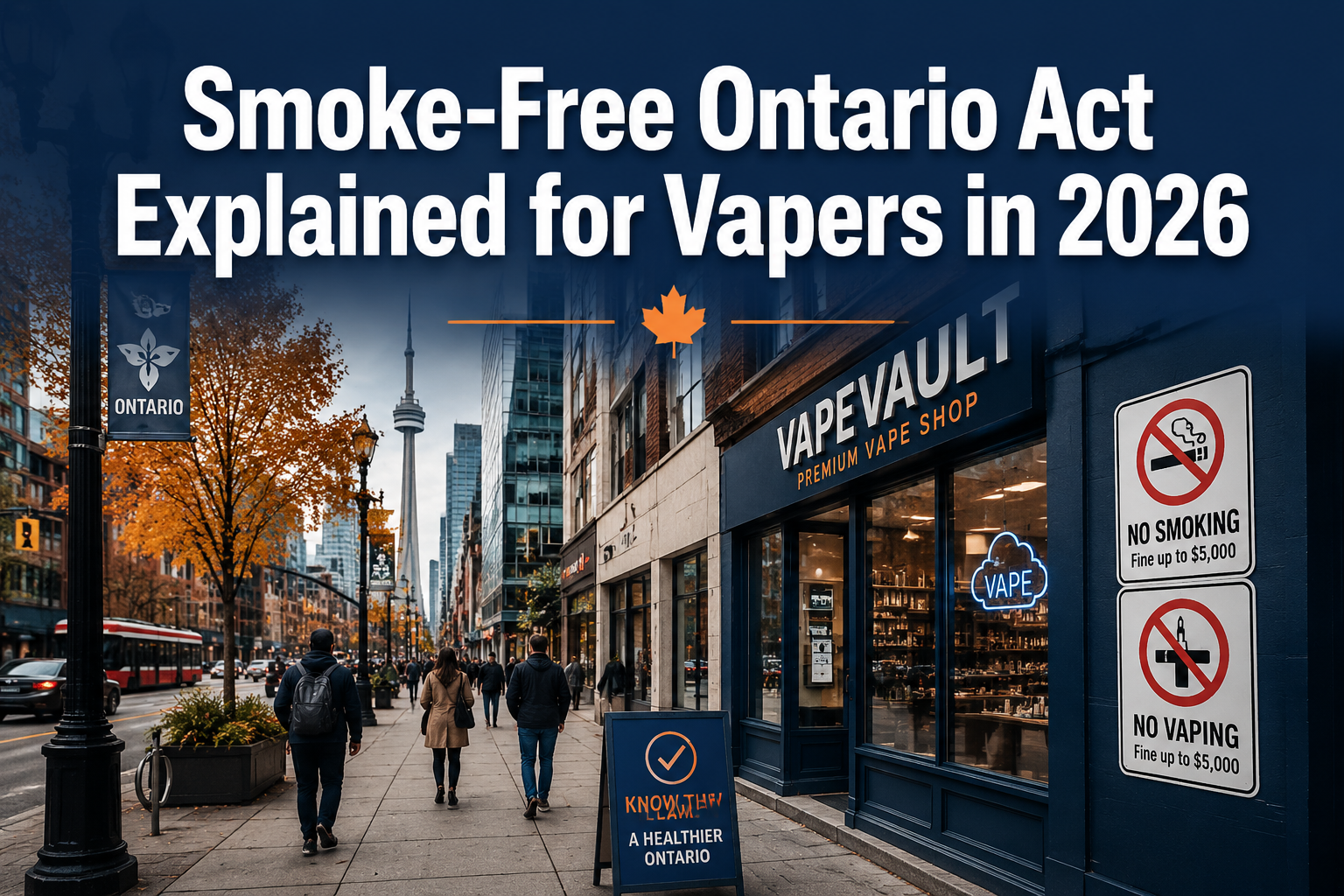
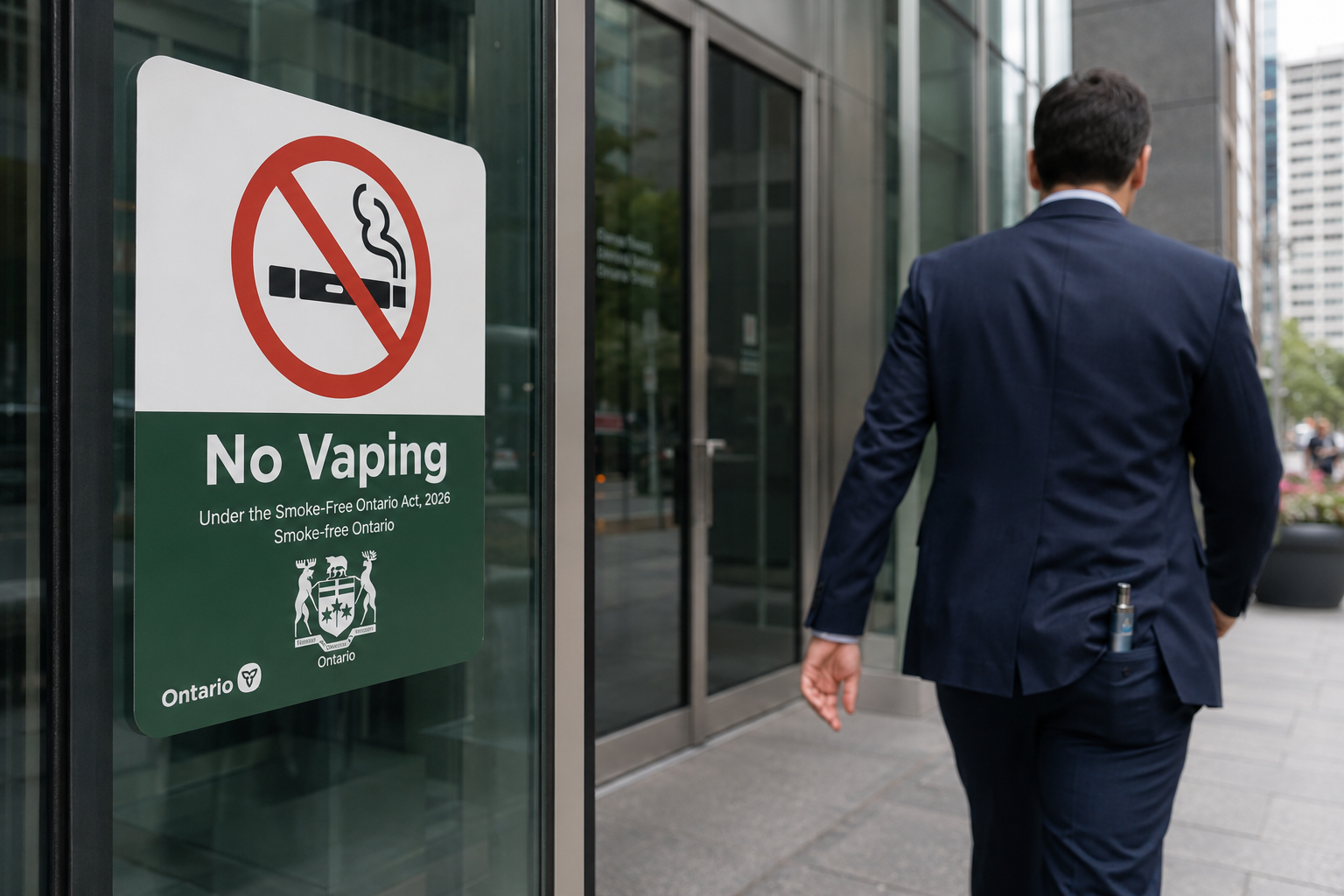
Establishments must post “No Smoking” and “No Vaping” signs at all entrances, exits, and washrooms. If you don’t see signage, that doesn’t mean vaping is allowed — the law applies regardless.
How Much Will Vape Fines Be If I Break the New Law
Fines under the SFOA are significant and escalate for repeat offences. An individual caught vaping in a prohibited area faces a minimum fine of $1,000 for a first offence, rising to $5,000 for subsequent violations.
Here’s a breakdown of the penalty structure:
| Offence Type | First Offence | Subsequent Offences |
|---|---|---|
| Individual vaping in a prohibited area | $1,000 | Up to $5,000 |
| Selling/supplying vape products to a minor | Up to $4,000 | Up to $25,000 |
| Corporation violating the Act | Up to $50,000 | Up to $100,000 |
| Failing to post required signage (business) | $1,000 | Up to $5,000 |
Common mistake: Many vapers assume that because enforcement is complaint-driven, the risk is low. In reality, Public Health Inspectors conduct proactive inspections, and any member of the public can file a complaint. Inspectors have the authority to enter premises without a warrant during business hours.
What Happens If I Get Caught Vaping Somewhere Illegal
If caught vaping in a prohibited area, a Public Health Inspector or bylaw officer can issue a Provincial Offences ticket on the spot. The process works similarly to receiving a traffic ticket.
Here’s what typically happens:
- Verbal warning or ticket: An inspector may issue a warning for a first-time, minor infraction, but they are not required to. They can issue a ticket immediately.
- Provincial Offences ticket: The ticket specifies the fine amount and the offence under the SFOA.
- Court option: Like a traffic ticket, you can pay the fine, request a meeting with the prosecutor, or contest it in court.
- Record: SFOA convictions are recorded under the Provincial Offences Act. They are not criminal offences and won’t appear on a criminal record check.
Edge case: If you’re vaping on private commercial property (like a strip mall parking lot), the property owner or manager can ask you to stop. If you refuse, they can call bylaw enforcement. The SFOA applies to the 9-metre buffer zone around any enclosed public space, which often extends into parking lots.
Are There Different Rules for People Under 18 Versus Adults
Yes, and the rules are stricter than many people realize. Under current Ontario law, no one under 19 can purchase, attempt to purchase, or possess vape products. If Bill 125 passes, that age would rise to 21.
Current rules for minors (under 19):
- It is illegal for any retailer to sell or supply vape products to anyone under 19.
- Minors found in possession of vape products can have them confiscated.
- Adults who supply vape products to minors face fines of up to $4,000 for a first offence and up to $25,000 for repeat offences.
- Retailers must request ID from anyone who appears under 25.
What Bill 125 would change:
- The purchase age would increase to 21, meaning anyone aged 19 or 20 would also be restricted.
- Specialty vape stores would need local health board approval, adding another layer of age-verification oversight.
- The online sales ban would close a common avenue that minors use to obtain vape products.
Decision rule: If you’re an adult over 19 (or 21 if Bill 125 passes), you can legally purchase and possess vape products. But you must still follow all location-based restrictions. Being of legal age does not give you the right to vape in prohibited areas.
If you’re new to vaping and want to understand your options, this guide to disposable vapes for curious adults covers the basics.
How Does This Law Compare to Smoking Restrictions
The SFOA treats vaping and smoking almost identically in terms of where each activity is banned. Every location where smoking is prohibited, vaping is also prohibited. The differences are minor but worth knowing.
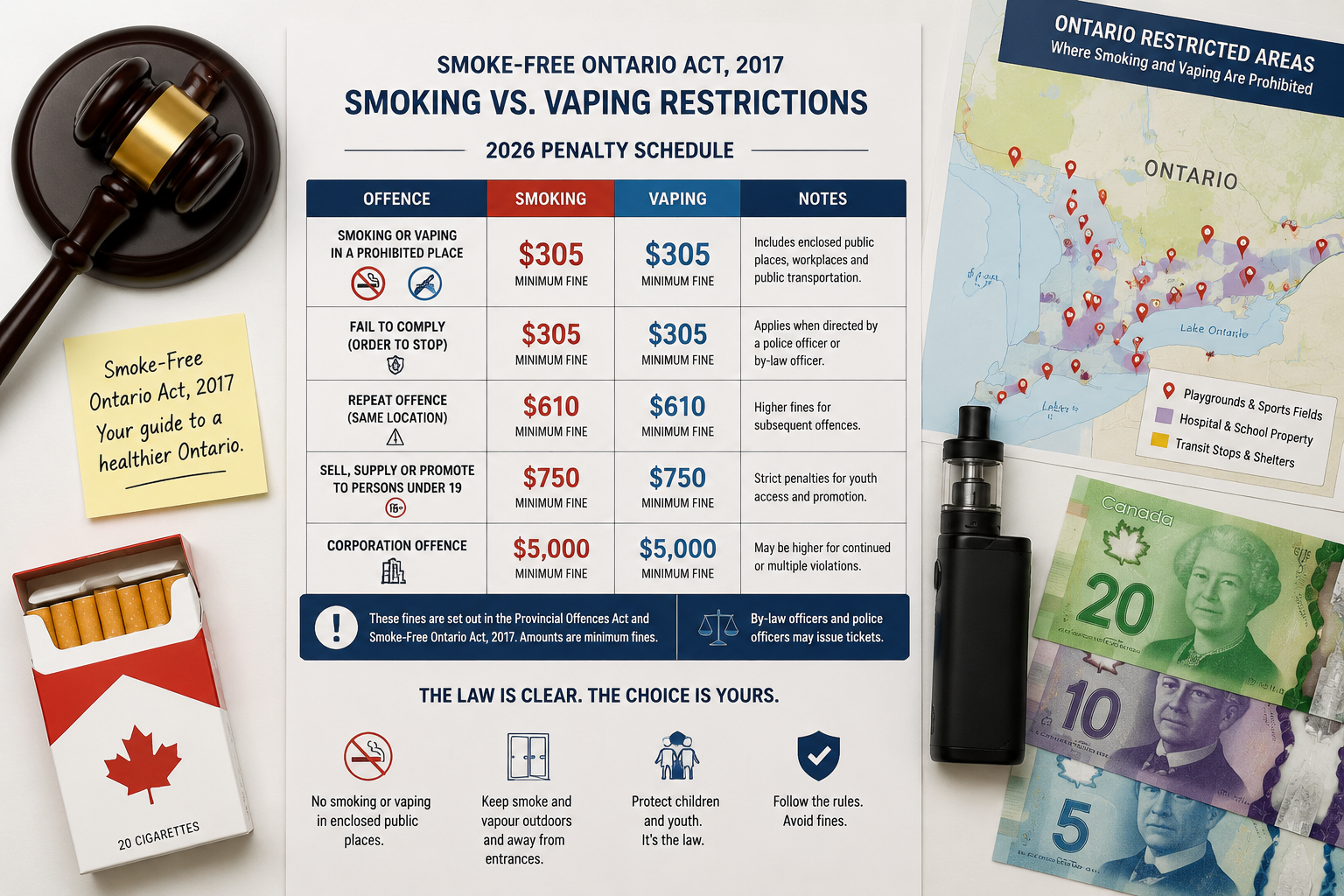
Similarities:
- Both are banned in all enclosed public spaces and workplaces
- Both are banned on restaurant and bar patios
- Both are subject to the 9-metre buffer zone rule
- Both carry the same fine structure for location-based offences
- Both require retailers to keep products out of consumer view
Differences:
| Category | Smoking (Tobacco) | Vaping |
|---|---|---|
| Product display | Hidden from view | Hidden from view |
| Flavour restrictions (proposed) | Menthol already banned federally | Bill 125 would ban all non-tobacco flavours |
| Federal excise tax | Yes | Yes (since 2022) |
| Designated smoking rooms | Banned | Banned |
| Cannabis-specific rules | Additional Cannabis Act restrictions | Additional Cannabis Act restrictions |
| Proposed age change (Bill 125) | 19 to 21 | 19 to 21 |
The practical takeaway: if you can’t smoke somewhere, you can’t vape there either. Don’t assume that because vaping produces vapour instead of smoke, it gets a pass. It doesn’t.
What’s the Difference Between Nicotine and Non-Nicotine Vape Rules
Under the SFOA, there is no distinction between nicotine-containing and nicotine-free vape products when it comes to where you can use them. Both are classified as “vapour products” and both are subject to the same location bans, signage requirements, and sales restrictions.
This surprises many vapers who assume that nicotine-free e-liquids fall outside the law. They don’t. The SFOA defines “vaping” broadly — it covers inhaling or exhaling vapour from an electronic cigarette or similar device, regardless of what the liquid contains.
Where nicotine content does matter:
- Federal regulations: Health Canada’s nicotine cap of 20 mg/mL applies to all nicotine-containing vape products sold in Canada. Learn more about what the nicotine cap means for vapers.
- Bill 125 proposals: The proposed nicotine restrictions in Bill 125 would add provincial limits on top of federal ones.
- Purchase age: Both nicotine and non-nicotine products require the buyer to be 19+ (or 21+ if Bill 125 passes).
Common mistake: Buying a nicotine-free vape and assuming it’s unregulated. The device itself and the act of using it are regulated under the SFOA, not just the nicotine content.
Can I Vape in My Apartment or Rental Unit
Yes, you can generally vape inside a private apartment or rental unit because the SFOA does not apply to private dwellings. However, your landlord or condo board can restrict or ban vaping through lease agreements, building rules, or condo bylaws.
Here’s how it breaks down:
- SFOA: Does not prohibit vaping inside a private residence, including apartments and condos.
- Lease agreements: A landlord can include a no-vaping clause in a new lease. If your existing lease doesn’t mention vaping, the landlord generally can’t add that restriction mid-lease without your agreement.
- Condo corporations: Condo boards can pass bylaws banning vaping in units and on common elements (hallways, balconies, parking garages). These bylaws are enforceable.
- Common areas: Hallways, lobbies, elevators, laundry rooms, and other shared indoor spaces in apartment buildings are enclosed public spaces under the SFOA. Vaping is banned there regardless of what your lease says.
- Balconies: Some municipalities and condo boards ban vaping on balconies. Check your specific building’s rules.
Decision rule: If you rent, read your lease carefully before vaping indoors. If you own a condo, review your condo corporation’s declaration and bylaws. When in doubt, ask your property manager directly.
Are There Any Exceptions for Cannabis Vapes
Cannabis vapes are subject to the SFOA and the Cannabis Act, 2017, which means they face a double layer of restrictions. There are no exceptions that make cannabis vaping more permissible than nicotine vaping — in fact, cannabis vaping is more restricted in some situations.
Key rules for cannabis vapes:
- All SFOA location bans apply (enclosed public spaces, workplaces, patios, 9-metre zones, etc.)
- Cannabis cannot be consumed in any vehicle, whether moving or parked
- Cannabis vaping is banned in all areas where children commonly gather, including parks, playgrounds, and sports fields
- Some municipalities have additional cannabis-specific bylaws that further restrict where you can consume
- Cannabis vape products must be purchased from the Ontario Cannabis Store (OCS) or authorized retailers — they cannot be sold in regular vape shops
Edge case: If you live in a condo and your building bans cannabis smoking but doesn’t specifically mention cannabis vaping, the restriction likely still applies. Most condo bylaws use broad language covering “cannabis consumption” or “smoking and vaping of any substance.”
How Will Schools and Universities Enforce These New Vaping Rules
Schools and universities in Ontario enforce a complete ban on vaping across all property, including buildings, grounds, parking lots, and vehicles on school property. Enforcement involves both the school’s own disciplinary process and potential SFOA fines from Public Health Inspectors.
Elementary and secondary schools:
- The SFOA bans vaping on all school property and within a prescribed distance of school grounds.
- School boards have their own policies that may impose suspensions or expulsions for vaping.
- Staff are expected to report violations. Schools can confiscate vape devices.
- Public Health Units conduct inspections of school properties.
Colleges and universities:
- Post-secondary institutions enforce the SFOA on all campus property.
- Most have designated areas far from buildings where smoking and vaping are tolerated, but these are campus policies, not SFOA exceptions.
- Campus security can issue trespass warnings to repeat offenders.
- Students caught vaping indoors or in prohibited outdoor areas can face both institutional discipline and provincial fines.
Common mistake for students: Assuming that vaping in a car parked on school property is allowed. It isn’t — the SFOA applies to vehicles on school grounds.
Do Workplace Smoking Areas Also Apply to Vaping Now
Yes. Under the SFOA, any workplace smoking restriction automatically applies to vaping as well. There are no separate “vaping areas” permitted under Ontario law. If a workplace has eliminated its designated smoking area, vaping is also prohibited in that location.
What this means in practice:
- Employers cannot create indoor vaping rooms or lounges.
- Outdoor designated smoking areas (where they exist) may be used for vaping, but they must comply with the 9-metre rule and cannot be on patios or in enclosed spaces.
- Employers can impose stricter rules than the SFOA requires. Many workplaces ban vaping on the entire property, including parking lots.
- Construction sites, warehouses, and other industrial workplaces follow the same rules as office buildings.
Employer obligations:
- Post “No Smoking” and “No Vaping” signs at all entrances, exits, and washrooms.
- Ensure compliance among employees, contractors, and visitors.
- Respond to complaints and cooperate with Public Health Inspectors.
Edge case: If you work from home, the SFOA does not apply to your private residence. But if clients or coworkers visit your home office, best practice is to avoid vaping during those meetings.
For those in the vape retail business, understanding these workplace rules is essential. Resources on choosing a wholesale vape supplier in Ontario can help retailers stay compliant while building their business.
What Retailers Need to Know About Selling Vape Products in 2026
Retailers face some of the strictest provisions under both the existing SFOA and the proposed Bill 125 amendments. Non-compliance can result in fines up to $100,000 for corporations and potential loss of the ability to sell vape products.
Current retail rules under the SFOA:
- Vape products must be kept out of sight — consumers cannot view or handle them before purchase.
- No promotion of vape products in retail settings where they can be seen by the public.
- Age verification is mandatory; retailers must ask for ID from anyone who appears under 25.
- All required signage must be posted.
Proposed changes under Bill 125:
- Vape products would only be sold in specialty vape stores or approved stores in remote communities.
- Convenience stores, gas stations, and other general retailers would lose the ability to sell vape products.
- Local health boards would need to approve specialty vape store operations.
- Online sales would be completely banned.
What this means for vapers: If Bill 125 passes, buying vape products will require a trip to a specialty store. Stocking up from trusted disposable vape retailers while current purchasing options remain available may be worth considering. Retailers looking to understand the wholesale side should review guidance on selling wholesale disposable vapes in Canada.
Frequently Asked Questions
Can I vape on a restaurant patio in Ontario? No. The SFOA explicitly bans both smoking and vaping on restaurant and bar patios across Ontario. This applies to all patios, whether they are enclosed, partially enclosed, or fully open-air.
Is vaping in a parked car legal? Generally yes, as long as the car is not on school property or other prohibited grounds. However, you cannot vape in a vehicle with anyone under 16 present, and cannabis vaping in any vehicle (moving or parked) is illegal.
Do the rules apply to nicotine-free vapes? Yes. The SFOA covers all vapour products regardless of nicotine content. If the device produces vapour that you inhale and exhale, it falls under the Act.
Will Bill 125 definitely become law? Not necessarily. Bill 125 is proposed legislation that must pass through readings, committee review, and a final vote in the Ontario Legislature. It could be amended, delayed, or not passed at all. The existing SFOA rules remain in effect regardless.
Can my landlord ban vaping in my apartment after I’ve signed the lease? Generally, a landlord cannot add new restrictions to an existing lease without your consent. However, condo boards can pass new bylaws that apply to all units. If you’re signing a new lease, check for vaping clauses before you sign.
Are there different rules in different Ontario cities? The SFOA is provincial law and applies uniformly across Ontario. However, some municipalities have additional bylaws that impose stricter rules, such as banning vaping in public parks or on sidewalks. Always check your local municipal bylaws.
What should I do if I see someone vaping in a prohibited area? You can report it to your local Public Health Unit. They handle SFOA enforcement and will investigate complaints. Most Public Health Units have online complaint forms.
Does the 9-metre rule apply to my own building’s entrance? If the building is an enclosed public space or enclosed workplace, yes. The 9-metre buffer zone extends from all entrances, exits, and air intakes. For private residences, the rule does not apply to your own home’s entrance.
Can vape shops let customers test products? Under the current SFOA, specialty vape shops may have limited provisions for product testing, but the rules are strict. Retailers should consult their local Public Health Unit for current guidance, as Bill 125 could change these provisions.
Are federal excise stamps required on legal vape products? Yes. Since 2022, all legally sold vape products in Canada must carry a federal excise stamp. Learn how to spot legal products by checking for excise stamps.
Will the flavour ban affect all vape products? If Bill 125 passes as written, all flavoured vape products except tobacco-flavoured ones would be banned in Ontario. This would affect the vast majority of products currently on the market.
How does Ontario’s law compare to other provinces? Ontario’s SFOA is among the stricter provincial frameworks. Some provinces have already raised their purchase age or banned flavours. Bill 125 would bring Ontario in line with or ahead of most other provinces if passed.
Conclusion
The Smoke-Free Ontario Act already imposes significant restrictions on where and how vapers can use their devices in 2026, and Bill 125 could make those rules much stricter. The core principle is straightforward: if you can’t smoke there, you can’t vape there.
Actionable next steps for Ontario vapers:
- Know the current rules. The SFOA bans vaping in all enclosed public spaces, workplaces, patios, and within 9 metres of building entrances. These rules are in effect right now.
- Watch Bill 125. Track the bill’s progress through the Ontario Legislature. If it passes, the purchase age, flavour options, and retail channels will all change significantly.
- Check your lease or condo bylaws. If you vape at home in a rental or condo, confirm that your building’s rules permit it.
- Carry ID. Retailers must verify age, and the threshold for requesting ID is appearance under 25. Always have government-issued ID when purchasing.
- Buy from legal sources. Ensure your vape products carry federal excise stamps and comply with Health Canada’s nicotine limits. Purchasing from reputable Canadian vape retailers protects both your health and your legal standing.
The regulatory environment for vaping in Ontario is evolving quickly. Staying informed isn’t optional — it’s the difference between vaping legally and facing a $1,000 fine.