






Last updated: July 20, 2026
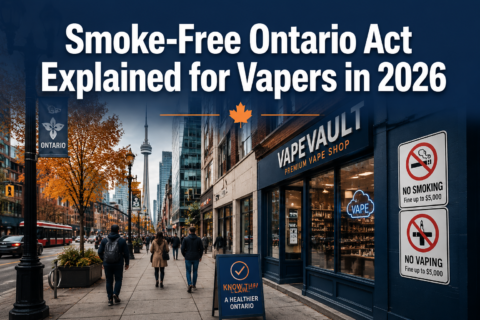
Quick Answer: Ontario’s Smoke-Free Ontario Act (SFOA) bans vaping in all enclosed public spaces, restaurant and bar patios, and vehicles carrying anyone under 16. These provincial rules apply across every Ontario city, but individual municipalities like Toronto, Ottawa, and Hamilton can add stricter local bylaws. As of July 1, 2026, the legal age to purchase vaping products in Ontario is 21, up from 19.
Key Takeaways
- The SFOA treats vaping the same as smoking in nearly every restricted location, including patios, playgrounds, and hospital grounds.
- Vaping in a vehicle or boat with a passenger under 16 is illegal province-wide and carries fines.
- Restaurant and bar patios are off-limits for vaping, plus a 9-metre buffer zone around patio entrances.
- First-time fines for vaping in a prohibited area start at $1,000 and rise to $5,000 for repeat offences.
- Municipal bylaws can extend restrictions beyond the provincial baseline; not all Ontario cities have identical rules.
- The minimum age to buy vapes in Ontario increased to 21 on July 1, 2026.
- Flavoured vaping products (except tobacco flavour) are now banned for sale in Ontario.
- Landlords and condo boards can legally ban vaping on private balconies and patios through lease terms or condo rules.
- Public health inspectors actively enforce vaping laws through inspections and complaint responses.
Where Can You Vape in Ontario Cities?
In short, the list of places where vaping is allowed in Ontario is much shorter than the list of places where it is banned. The SFOA prohibits vaping in enclosed public places, enclosed workplaces, and a long list of outdoor areas. That leaves private residences (subject to landlord or condo rules) and certain outdoor areas that are not specifically restricted.
Places where vaping is banned province-wide include:
- Enclosed public spaces (malls, stores, community centres)
- Enclosed workplaces and work vehicles
- Restaurant and bar patios (plus 9 metres from the patio)
- School grounds, child care centres, and playgrounds
- Sports fields and spectator areas
- Hospital properties
- Within 9 metres of entrances and exits of long-term care homes
- Indoor common areas of apartment buildings, condos, and college or university residences (hallways, stairwells, lobbies, laundry rooms)
Places where vaping is generally permitted:
- Inside a private home (unless a lease or condo bylaw says otherwise)
- On a public sidewalk that is not within a restricted buffer zone
- In a private vehicle, as long as no one under 16 is present
For a detailed breakdown of the 9-metre buffer rule and other location-specific restrictions, see the guide on where you can and cannot vape in Ontario.
Are Vapes Allowed on Patios in Toronto?

No. Vaping on restaurant and bar patios is banned across all of Ontario, including Toronto. The SFOA specifically lists patios associated with food or drink service as prohibited zones. The ban also extends 9 metres outward from the patio’s perimeter, which means standing just off the patio edge does not make it legal.
Toronto does not grant any special exemptions for patios. The city’s municipal code reinforces the provincial rules, and Toronto Public Health inspectors conduct regular compliance checks at licensed food establishments. A business that allows vaping on its patio risks fines and potential licence complications.
Common mistake: Some vapers assume that because a patio is “outdoors,” it falls outside the smoking and vaping ban. The SFOA explicitly covers outdoor patios attached to restaurants and bars, regardless of whether they have a roof or walls.

Can You Vape in Your Car in Ontario?
Yes, but only if every passenger is 16 or older. Ontario law prohibits smoking or vaping in any motor vehicle or boat when a person under 16 is present. This rule applies whether the vehicle is moving or parked, and whether the windows are open or closed.
Key details about the vehicle rule:
- It covers all motor vehicles: cars, trucks, SUVs, vans, and recreational vehicles.
- It also covers boats.
- The restriction is based on the age of the youngest occupant, not the driver.
- The driver or any adult passenger who vapes while a minor under 16 is present can be fined.
If every person in the vehicle is 16 or older, vaping is legal inside the car. However, work vehicles fall under the enclosed-workplace ban, so vaping in a company van or delivery truck is prohibited regardless of passenger age.
For more context on how these rules fit into the broader regulatory picture, the Smoke-Free Ontario Act explained for vapers covers the full scope of the legislation.

Can You Get Fined for Vaping in a Vehicle with Kids?
Yes. Vaping in a vehicle with anyone under 16 is a provincial offence. Fines for this violation follow the same penalty structure as other SFOA infractions: $1,000 for a first offence and up to $5,000 for subsequent offences. Law enforcement officers can issue tickets on the spot.
Choose awareness over risk: Even if a child is sleeping or the windows are down, the law still applies. There is no exception for brief use, partially open windows, or the child being in the back seat.
What Counts as a Public Space for Vaping Rules?
Under the SFOA, a “public space” for vaping purposes includes any enclosed area that the public can access, plus a broad list of specific outdoor locations. The definition is wider than many people expect.
Enclosed public spaces include:
- Shopping malls and retail stores
- Libraries and community centres
- Arenas and concert venues
- Public transit vehicles and shelters
- Government offices
- Common areas in multi-unit residential buildings
Outdoor public spaces that are also restricted:
- Playgrounds and splash pads
- Sports fields, courts, and surrounding spectator areas
- School grounds (public and private)
- Child care centre grounds
- Hospital grounds
- Within 9 metres of entrances/exits of certain buildings (long-term care homes, public buildings in some municipalities)
The definition does not include open sidewalks or parks in general under provincial law, though some municipalities have added parks to their restricted lists through local bylaws.
Are There Different Vaping Rules in Ottawa vs Toronto?
The provincial baseline is the same in Ottawa and Toronto because both cities fall under the SFOA. However, each municipality can layer additional bylaws on top of the provincial rules.
Ottawa: The city enforces the SFOA and has added restrictions in certain municipal properties and parks. Ottawa Public Health conducts inspections and responds to complaints about vaping in prohibited areas.
Toronto: Toronto similarly enforces the SFOA and has extended some restrictions to cover additional municipal properties, including certain outdoor public spaces managed by the city.
Hamilton: As another example, Hamilton has enacted its own smoke-free and vape-free bylaws that apply to public places and workplaces, sometimes going beyond the provincial minimum.
Decision rule: If you are visiting a new Ontario city, assume the provincial rules apply everywhere, and then check the local municipal website for any additional restrictions. The safest approach is to treat all indoor public spaces, patios, playgrounds, sports fields, and areas near building entrances as off-limits.
Vaping Laws by Ontario City: A Side-by-Side Comparison
All Ontario cities share the same provincial floor set by the SFOA. The differences come from municipal bylaws that add restrictions. Here is a comparison of how several major cities handle common vaping scenarios:
| Rule | Toronto | Ottawa | Hamilton | London |
|---|---|---|---|---|
| Restaurant patio ban | Yes (SFOA) | Yes (SFOA) | Yes (SFOA + bylaw) | Yes (SFOA) |
| 9-metre buffer zone | Yes | Yes | Yes | Yes |
| Vehicle ban (under 16) | Yes (SFOA) | Yes (SFOA) | Yes (SFOA) | Yes (SFOA) |
| Parks and trails ban | Select parks | Select areas | Municipal parks | Select parks |
| Additional municipal bylaws | Yes | Yes | Yes | Yes |
| Minimum purchase age | 21 (provincial) | 21 (provincial) | 21 (provincial) | 21 (provincial) |
The main takeaway: the core rules are consistent, but municipalities like Hamilton have layered on extra park and public-space restrictions. Always check local bylaws when travelling between cities.
Do All Ontario Cities Have the Same Vaping Restrictions?
No. While every Ontario city must follow the SFOA as a minimum standard, municipalities have the authority to pass stricter bylaws. No city can relax the provincial rules, but any city can tighten them.
Examples of municipal variation:
- Hamilton has enacted comprehensive smoke-free and vape-free bylaws covering additional public places and workplaces beyond the SFOA.
- Toronto has extended restrictions to certain city-managed outdoor spaces and events.
- Thunder Bay and other northern communities see active enforcement through their local public health units, which conduct inspections and respond to complaints.
Edge case: Smaller towns and rural municipalities may not have additional bylaws, meaning only the provincial SFOA applies. But enforcement still happens through local public health inspectors.
For a complete overview of the provincial legislation that forms the baseline, the complete guide for adults on vaping laws in Ontario is a helpful resource.
Are Vapes Banned on Restaurant Patios in Ontario?
Yes, without exception. The SFOA bans both smoking and vaping on all restaurant and bar patios across Ontario. This applies to every type of food-service patio, whether it is a rooftop terrace, a sidewalk cafe, or a fenced-off seating area beside a bar.
The 9-metre rule adds a buffer: you cannot vape within 9 metres of the patio boundary. In practice, this means stepping well away from the establishment before using a vape.
Business owners take note: Restaurants that fail to enforce the patio ban can face fines. Operators are expected to post signage and ask patrons to comply. Public health inspectors can issue orders and penalties to the business, not just the individual vaper.
How Do Ontario Vaping Rules Differ from Smoking Rules?
The SFOA applies the same location-based restrictions to vaping as it does to smoking. In 2026, there is no practical difference between where you can smoke a cigarette and where you can use a vape in Ontario. Every place that bans smoking also bans vaping.
However, there are a few distinctions in the broader regulatory framework:
- Product restrictions: Flavoured vaping products (except tobacco flavour) are now banned for sale in Ontario. Cigarettes have long had flavour restrictions, but the vape flavour ban is newer and more sweeping. For details on what flavours remain available, see the breakdown of the only flavours allowed in Ontario convenience stores.
- Sales channels: Vaping products can now only be sold in specialty vape stores or designated stores in remote or rural communities. Online sales of vaping products are prohibited. Cigarettes have different (though also restricted) retail rules.
- Promotion: All promotion of vaping products is banned, which aligns with but is distinct from tobacco advertising restrictions.
- Age: The purchase age for both tobacco and vaping products is now 21 as of July 1, 2026.
Bottom line: For the question of where you can use the product, the rules are identical. The differences show up in how the products are sold and marketed.
What Happens If You Vape Where It’s Not Allowed in Ontario?
Fines are real and enforced. A first offence for vaping in a prohibited area carries a fine of $1,000. Subsequent offences can result in fines up to $5,000. These penalties apply to individuals.
Enforcement process:
- Public health inspectors, bylaw officers, or police can issue tickets.
- Complaints from the public trigger inspections. Local public health units actively respond to reports.
- Businesses that allow vaping in prohibited areas face their own penalties, which can be higher than individual fines.
- Repeat offenders may face escalating consequences.
Common scenario: A patron vapes on a restaurant patio. Another customer or staff member reports it. A public health inspector follows up. Both the individual and the business could face consequences if the business did not take reasonable steps to prevent it.
This is not theoretical. Public health units across Ontario, from the Thunder Bay District Health Unit to Toronto Public Health, conduct regular inspections and enforce the SFOA.
Can Landlords Ban Vaping on Apartment Patios?
Yes. While the SFOA covers indoor common areas of residential buildings (hallways, lobbies, stairwells), it does not specifically ban vaping inside individual rental units or on private balconies. However, landlords and condo boards can fill that gap through lease agreements and condo bylaws.
How this works in practice:
- Rental apartments: A landlord can include a no-vaping clause in the lease. If the tenant agrees to the lease, the clause is enforceable. New leases in Ontario increasingly include such clauses.
- Condominiums: Condo boards can pass rules or amend declarations to ban smoking and vaping on balconies and in units. Once passed through the proper process, these rules are binding on all unit owners and tenants.
- Existing leases: Changing the terms of an existing lease is more complicated. A landlord generally cannot unilaterally add a no-vaping clause mid-lease without the tenant’s agreement, though condo rule changes can apply to all residents once properly enacted.
Decision rule: If you rent or own in a multi-unit building, check your lease or condo rules before vaping on your balcony or patio. The provincial law may not ban it, but your building’s rules might.
Are There Exceptions to Vaping Bans in Ontario Public Spaces?
Very few. The SFOA includes limited exceptions, and none of them apply to casual recreational vaping.
The narrow exceptions include:
- Controlled acts in specific settings: Some long-term care homes and certain residential care facilities may have designated smoking or vaping areas, subject to strict conditions and local health unit approval.
- Scientific or medical research: Vaping in a controlled research environment may be permitted under specific authorizations.
- First Nations reserves: Provincial laws may apply differently on reserve lands, depending on the specific governance arrangements.
There is no general exception for:
- Being outdoors (patios, playgrounds, and sports fields are still banned)
- Using a “low-vapour” or “no-smell” device
- Vaping cannabis versus nicotine (both are covered)
- Being alone in a public space
The safest assumption is that if a space is listed in the SFOA or a municipal bylaw, vaping is not allowed there, period.
How Old Do You Have to Be to Vape in Ontario?
As of July 1, 2026, you must be at least 21 years old to purchase tobacco or vaping products in Ontario. This is a significant change from the previous minimum age of 19.
What the age increase means:
- Retailers must verify age before selling any vaping product. Anyone who looks under 25 should expect to be asked for ID.
- The age restriction applies to all sales channels, though online vape sales are now prohibited in Ontario anyway.
- The age to use a vape in a private setting is not explicitly set by the SFOA (the law targets sales and public use), but purchasing under 21 is illegal.
For retailers: Selling vaping products to anyone under 21 carries significant penalties. Vape shop owners should review the complete guide to vaping laws in Ontario for 2026 and ensure staff training reflects the new age threshold.
Those looking for compliant products available through legal channels can explore options at specialty vape retailers that verify age at point of sale.
Understanding the 9-Metre Rule and Buffer Zones
The 9-metre rule is one of the most frequently misunderstood parts of Ontario’s vaping regulations. It requires that vapers stay at least 9 metres (roughly 30 feet) from the entrance or exit of certain buildings and areas.
The 9-metre buffer applies to:
- Entrances and exits of enclosed public places and enclosed workplaces
- Restaurant and bar patios (9 metres from the patio perimeter)
- Entrances and exits of long-term care homes
- Other locations specified by municipal bylaws
Practical tip: Nine metres is about the length of a school bus. When stepping outside a building to vape, walking to the far side of the parking lot is usually a safe bet. Standing just outside the door is almost certainly within the restricted zone.
For a thorough walkthrough of how the 9-metre rule works in different scenarios, the guide to the 9-metre rule covers the details.
Recent Changes Affecting Vaping Rules Across Ontario Cities
Ontario’s vaping regulations have tightened considerably in recent years. The most significant changes taking effect in 2026 include:
- Age increase to 21: Effective July 1, 2026, raising the legal purchase age from 19 to 21.
- Flavour ban: Only tobacco-flavoured vaping products can now be sold. The ban on flavoured products is designed to reduce the appeal of vaping to younger people.
- Sales channel restrictions: Vaping products can only be sold in specialty vape stores or designated stores in remote communities. Online sales are prohibited.
- Promotion ban: All promotion of vaping products is now banned.
These changes apply uniformly across Ontario. No city is exempt, and no municipality can opt out of the provincial rules.
For retailers navigating these changes, understanding vape shop display rules is critical to staying compliant while maintaining a viable business.
FAQ
Can I vape on my own apartment balcony in Ontario? Provincial law does not specifically ban vaping on private balconies. However, your landlord or condo board can prohibit it through lease terms or building rules. Check your rental agreement or condo bylaws before vaping on your balcony.
Is vaping in a parked car legal in Ontario? Yes, as long as no one in the vehicle is under 16. The ban on vaping in vehicles applies whether the car is moving or stationary.
Do vaping rules apply to cannabis vapes too? Yes. The SFOA covers all forms of vaping, including cannabis vaporizers. The same location restrictions that apply to nicotine vapes apply to cannabis vapes.
Can a restaurant owner allow vaping on their patio if customers consent? No. The patio vaping ban is a provincial law, not a business policy. Customer consent does not override the SFOA. A restaurant that permits vaping on its patio can be fined.
What is the fine for vaping in a prohibited area in Ontario? The fine is $1,000 for a first offence and up to $5,000 for subsequent offences. Businesses that allow violations can face separate, often higher, penalties.
Are hookah lounges or vape lounges legal in Ontario? The SFOA bans vaping in enclosed public places, which includes lounges. Some establishments that operated before the law was enacted may have sought legal challenges, but the general rule is that indoor vaping lounges are not permitted.
Can I vape at an outdoor concert or festival in Ontario? It depends on the venue. Many outdoor events take place on municipal property where additional bylaws may apply. Even without a specific bylaw, event organizers often prohibit vaping in spectator areas. Check the event’s rules before attending.
Does the 9-metre rule apply to my home’s front door? No. The 9-metre rule applies to entrances and exits of enclosed public places, workplaces, and specific facilities like long-term care homes. It does not apply to private residences.
Can police pull me over for vaping while driving? Police can pull you over if they have reason to believe a child under 16 is in the vehicle and someone is vaping. Vaping alone while driving (without minors present) is not itself a traffic offence, though distracted driving laws could apply if the device impairs your ability to drive safely.
Is the legal vaping age 19 or 21 in Ontario in 2026? It is 21 as of July 1, 2026. The age was raised from 19 to 21 under recent amendments to Ontario’s tobacco and vaping legislation.
Are disposable vapes still legal to buy in Ontario? Yes, disposable vapes are legal to purchase if they comply with all federal and provincial regulations, including the nicotine cap, flavour restrictions, and excise stamp requirements. They must be purchased from a licensed specialty vape store. For guidance on choosing compliant disposable vapes, several buyer’s guides are available.
Can my employer ban vaping in the parking lot? Yes. Employers can set workplace policies that go beyond the SFOA. A company can ban vaping anywhere on its property, including outdoor parking areas, as a condition of employment.
Conclusion
Ontario’s vaping rules in 2026 are straightforward in principle but layered in practice. The Smoke-Free Ontario Act sets a province-wide floor: no vaping in enclosed public spaces, on restaurant patios, near building entrances, or in vehicles with minors. Every Ontario city follows these rules. But municipalities like Toronto, Ottawa, and Hamilton can and do add their own restrictions on top.
Actionable next steps for vapers in Ontario:
- Know the provincial baseline. Assume that any indoor public space, patio, playground, sports field, or hospital ground is off-limits.
- Check local bylaws. Before vaping in a new city, visit the municipal website or call the local public health unit to ask about additional restrictions.
- Respect the 9-metre rule. Step well away from building entrances and patio perimeters, at least the length of a school bus.
- Never vape in a vehicle with anyone under 16. No exceptions, no workarounds.
- Verify your building’s rules. If you live in an apartment or condo, check your lease or condo bylaws for vaping restrictions on balconies and in units.
- Stay current. The legal purchase age is now 21, flavoured products are banned (except tobacco), and online sales are prohibited. These are new rules, and enforcement is active.
Understanding the rules protects you from fines and protects the people around you. When in doubt, step further away, wait until you are in a clearly permitted area, and vape responsibly.
SEO Meta Title: Vaping Rules Across Ontario Cities: Cars, Patios, Public Spaces
SEO Meta Description: Learn where you can and cannot vape across Ontario cities in 2026, including patio bans, vehicle rules, fines, and how municipal bylaws differ by city.